Insights / UAE · ADNOC
A Tender Wave Is Only as Fast as Its Slowest FEL
ADNOC has set its 2027 tender list and is cutting tender cycles by 40%. How mature each scope is remains undisclosed, and that decides whether the schedule holds.
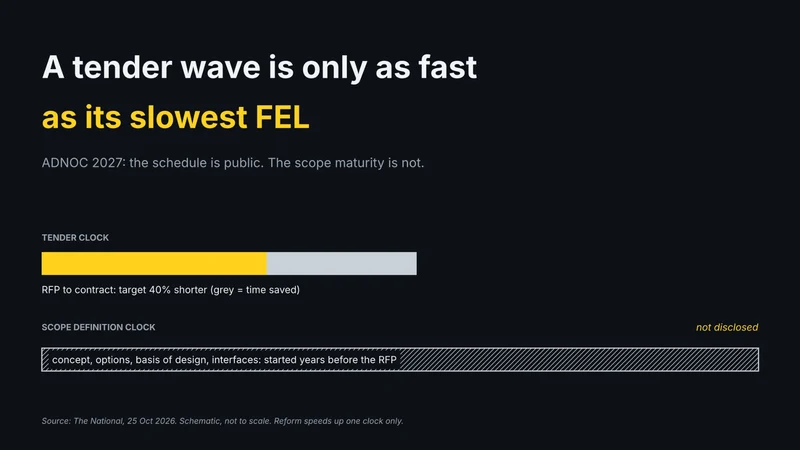
ADNOC has told its suppliers what goes to market in 2027. It has not told them how mature that scope is.
The schedule depends not only on what goes to market, but on how mature each scope is when it does.
At the second Make it with ADNOC forum in Abu Dhabi, Adel Al Yafei, senior vice president for group commercial operations and execution, told suppliers: "The demand is real, and the timeline is set."
The demand is visible. The timeline is stated. What is missing from the public picture is the one input that makes a stated timeline believable: how far each scope has progressed through FEL.
What is on the 2027 list
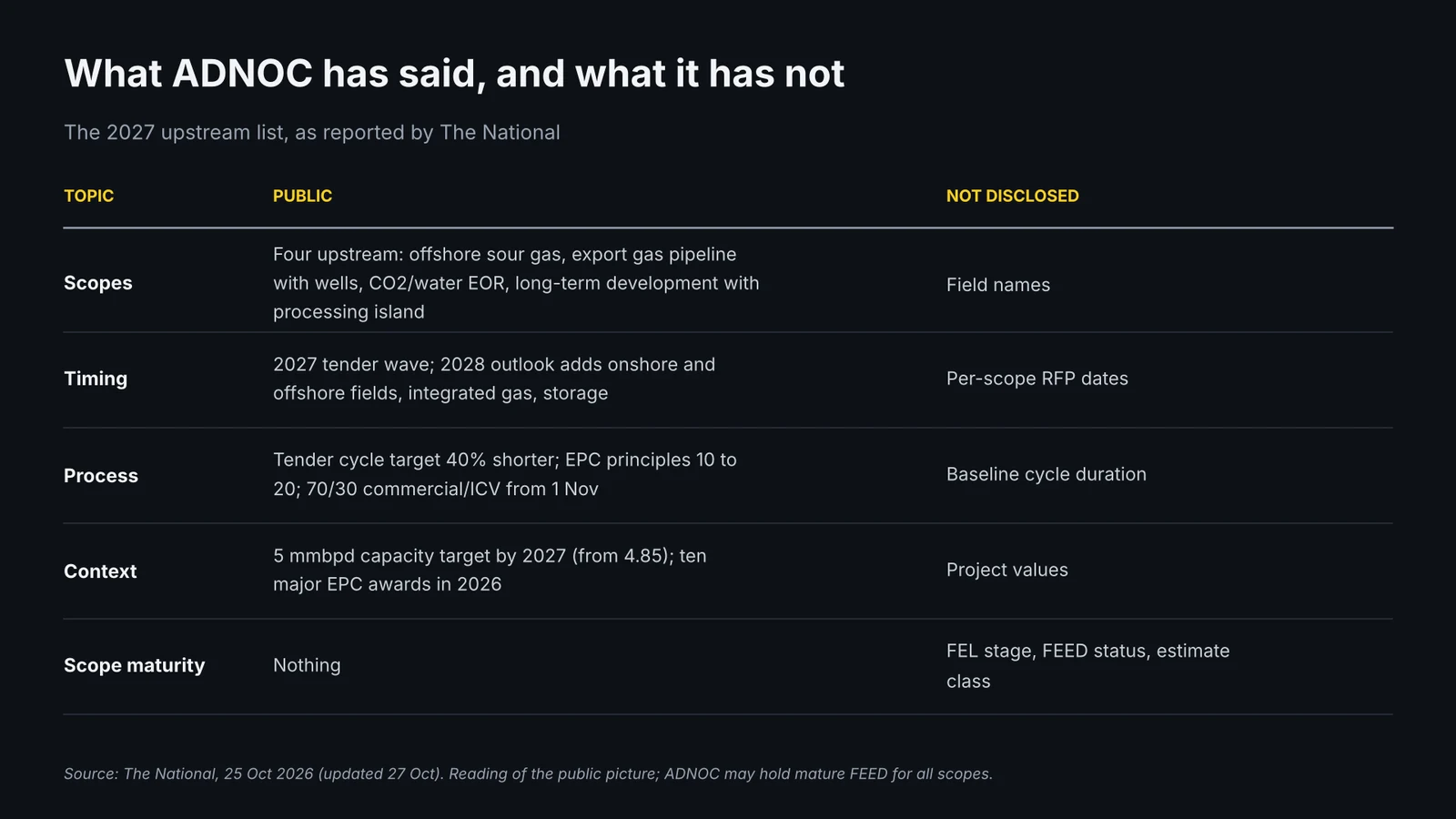
According to The National, the upstream scopes heading to tender next year are four: an offshore sour gas development with wellhead towers and pipelines; an export gas pipeline project with new wells and an offshore cluster; an enhanced oil recovery project using alternating injection of CO2 and water; and a long-term development with new wells, a processing island, offshore platforms, power distribution, an island power link and offshore field connections.
Downstream scopes (refinery residue upgrading, NGL and sulphur export berths) and drilling and maintenance services sit alongside them. The 2028 outlook adds onshore and offshore oilfield developments, an integrated onshore gas project and gas storage.
The context is a capacity push: ADNOC is seeking 5 million barrels per day of oil production capacity by 2027, up from 4.85 million, and has already awarded ten major EPC projects in 2026.
No project values were disclosed. No field names. No FEED status.
The procurement side is getting faster
Most of the announcement is about process, and the changes are substantial. ADNOC aims to cut tender cycle times by 40 percent. Al Yafei said that is "the time we save from our process, not the time we take from what you need to deliver." EPC contracting principles double from 10 to 20. For EPC tenders, the most competitive offer is prioritised, and ADNOC negotiates exclusively with that bidder if it meets the benchmark. From 1 November, commercial and ICV offers are scored together, 70 percent commercial and 30 percent ICV.
These are sensible changes, and bidders will welcome the clarity. But they speed up one clock.
A shorter tender cycle shortens the time between an RFP being issued and a contract being signed. It does nothing for the months or years before the RFP, where concept, option selection, basis of design and interface definition either get fixed or do not. Scope definition runs on a different clock, and no tender reform can make up its delay.
A precedent: Hail and Ghasha
There is a public example of how much can happen between FEED and a contract that sticks. The sequence below comes from MEED reporting (May 2023 and October 2023, subscription):
- 2019: Bechtel completes the FEED for the Hail and Ghasha sour gas project. Four EPC packages are tendered.
- Early 2021: after commercial bids, ADNOC revises the design to cut CAPEX, which had been estimated at up to USD 15 billion, and consolidates the four packages into two.
- January 2023: pre-construction services agreements are signed, about USD 80 million onshore and USD 60 million offshore.
- Late April 2023: the agreements are cancelled and a fresh EPC round is launched, now in three packages. MEED reports the reason as unclear. Sources said the cost estimates submitted were higher than ADNOC's overall budget.
- October 2023: EPC contracts of USD 16.94 billion are awarded, with FID announced at Adipec.
More than four years from FEED to award, though not all of that time reflects FEL maturity, and the packaging went from four to two, to three, to two.
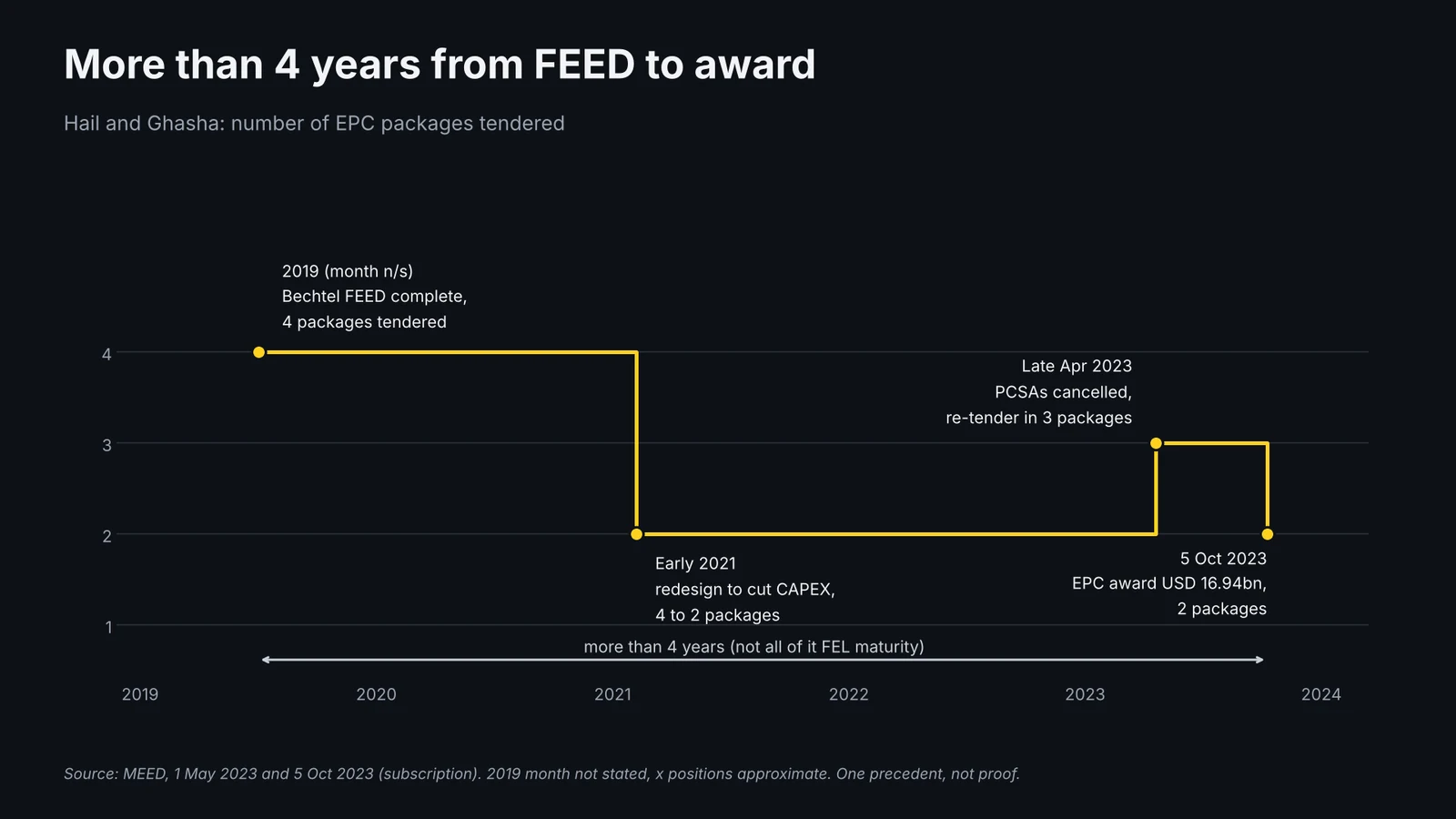
This does not prove that the FEED was immature. Mega-projects get re-baselined for many reasons, including market conditions between 2021 and 2023, budget decisions and strategy. The narrower point is this: even for an operator with ADNOC's capability, the gap between FEED and an award that holds can run for years, and the first public sign of misalignment came at bid stage, when estimates met the budget.
Why thin FEL shows up after the tender clock starts
Four mechanisms recur. This is engineering judgement rather than a claim about any specific ADNOC scope.
Bid spread. Where scope is soft, bidders read it differently. Price competition then rewards the bidder who assumes the most favourable reading. Exclusive negotiation with the most competitive offer can lock that reading in, and the difference returns later as change orders.
Interfaces. Tie-ins, shutdown windows, power and utilities cross package boundaries. Until someone owns them as a deliverable, they belong to nobody, and the EPC contractor finds them first. On brownfield scopes this is where schedule leaks.
Estimate against budget. An estimate with the wrong accuracy class for the decision produces the pattern seen at Hail and Ghasha: bids that land above the budget, after the tender is already running.
Existing-asset data. Offshore brownfield tie-ins depend on as-built information that may be years old. If it has not been validated before the RFP, the validation happens in execution.
Each one returns as change orders, re-FEED or a fresh tender. All of them cost more once the schedule is public.
A five-question readiness test before an RFP
- Is the concept frozen with a documented option record, so you can say what was rejected and why?
- What estimate class backs the budget, and what range does it state?
- Is there an interface register with tie-in points, shutdown windows and an owner for each?
- Is existing-asset data (as-builts, condition, capacity) validated for this scope?
- Is the production or injection profile basis frozen, with a range?
If any answer is no, the scope carries an unresolved maturity gap. It may still go to tender, but the gap should be visible, owned and priced.
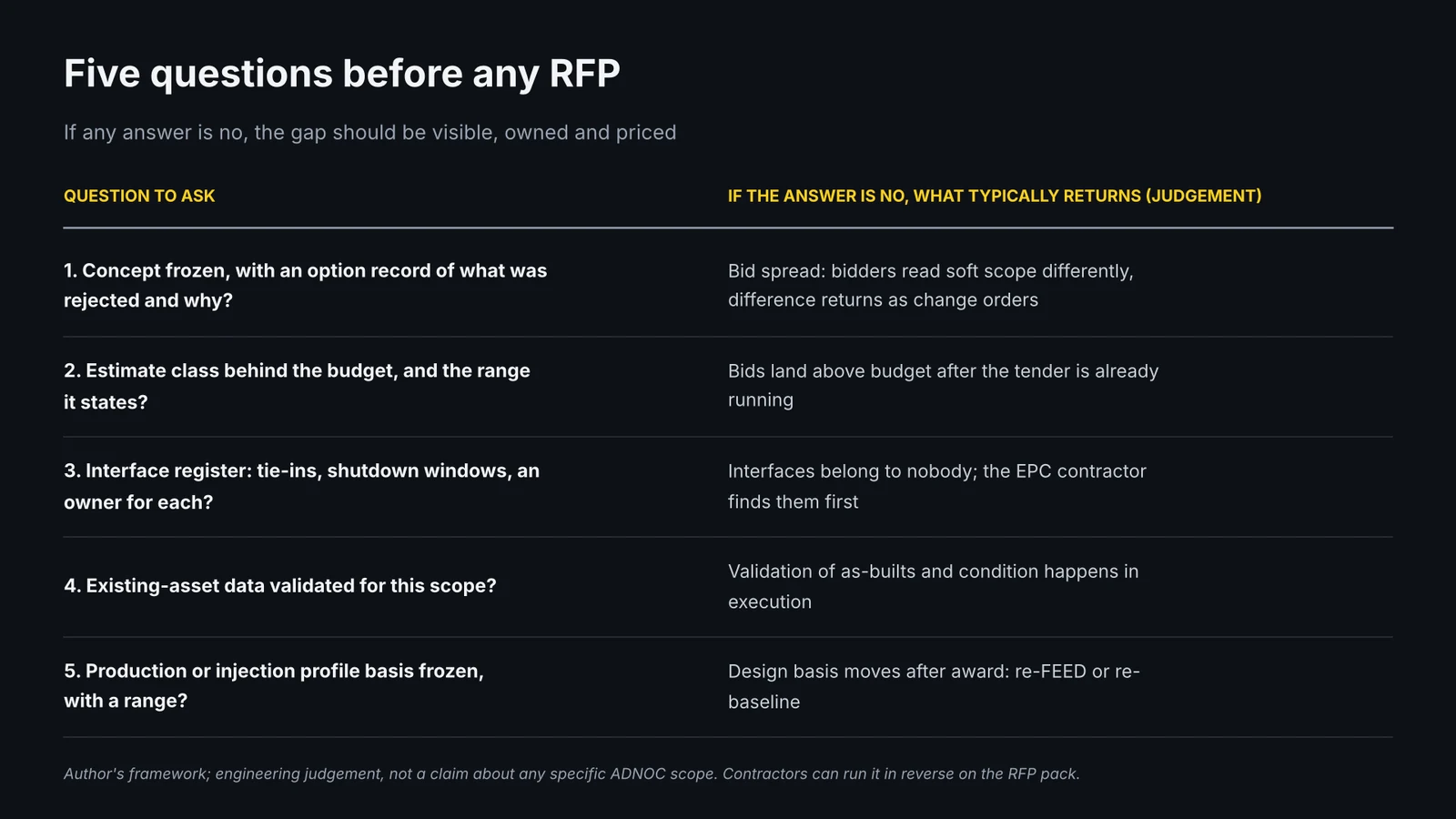
Contractors can use the same list in reverse: ask it of the RFP pack, and price the gaps explicitly instead of absorbing them.
Realisable value at portfolio level
I use a simple frame for early-phase decisions: Realisable Project Value = Economic Potential x Delivery Certainty.
On ADNOC's list, Economic Potential is large and well understood. Delivery Certainty is set before the RFP leaves the building.
At portfolio level, Delivery Certainty does not average. Where packages share tie-ins, power, processing or installation vessels, it compounds. As an illustration, take four packages of equal value, each with a delivery certainty of 0.9. If they are independent, the portfolio delivers 0.9 of its potential. If each depends on the previous one, the chain delivers 0.9 x 0.9 x 0.9 x 0.9, about 0.66. The numbers are invented for the arithmetic, not ADNOC data. It illustrates a chain of sequential dependencies, not a model of ADNOC's portfolio or of delivery certainty in general, since real packages are partly dependent and partly independent.
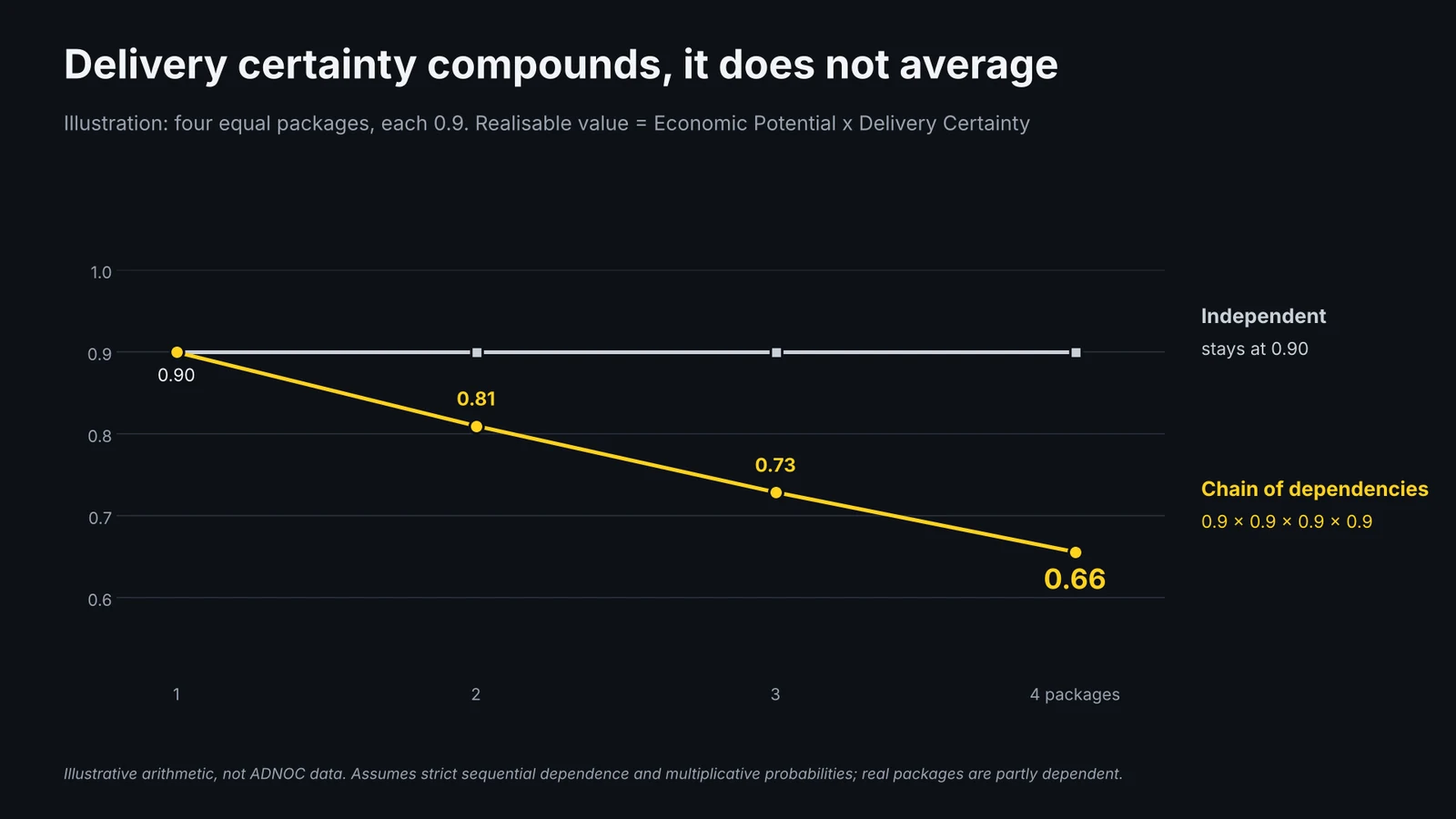
And the queue is already crowded. Ten EPC awards in 2026, four upstream scopes in 2027 and more in 2028 draw on the same engineering houses, yards and vessels.
I have written before on ADNOC portfolio sequencing and physical execution risk. This piece looks one step earlier: the state the scope is in when it joins the queue.
Where this argument has limits
I do not know the FEL stage of any scope on the list. The National names no fields and no FEED status, and ADNOC may well hold mature FEED packages for all of them.
Hail and Ghasha dates from 2019 to 2023. ADNOC has since changed its approach, with shorter cycles, doubled EPC principles and feedback to bidders, which may address part of this risk.
And the reason for the 2023 cancellation is reported by MEED from unofficial sources. I treat it as signal, not proof.
Calculation note
Hail and Ghasha timeline. FEED completed 2019 (month not stated), EPC award announced 5 October 2023, so more than 4 years. Packaging: 4, then 2, then 3, then 2.
Illustrative portfolio. Four packages of equal value, delivery certainty 0.9 each. Independent: 0.9 of potential. Chain-dependent: 0.9 x 0.9 = 0.81; x 0.9 = 0.729; x 0.9 = 0.656, about 0.66. Illustrative only: assumes strict sequential dependence and multiplicative probabilities.
Tender cycle. The 40 percent cut is ADNOC's stated target. The baseline duration is not disclosed, so I calculate no days.
Sources
- The National, 25 October 2026 (updated 27 October): ADNOC prepares new wave of oil and gas tenders for 2027
- MEED, 1 May 2023 (subscription): ADNOC begins fresh tender process for Hail and Ghasha
- MEED, 5 October 2023 (subscription): ADNOC awards $17bn EPC contracts for Hail and Ghasha
Working on a concept, Pre-FEED or a tender pack? A short call is often enough to see where the gaps are.