Insights / Gulf · Export routes
Around Hormuz, Not Through It: The Bypass Is Now the Constraint
Gulf exports are back above 80% of pre-war levels, but via bypass routes. An export route is a system of pipeline, storage, terminals and vessels, and each can bind.
Gulf oil exports recovered to more than 81% of pre-war levels in September. But the recovery did not mean the export system was back to normal.
According to Reuters, citing Vortexa data, Gulf exports excluding Iran averaged 19.2 million barrels per day in September, compared with 23.6 million bpd before the war. Crude and condensate exports recovered to 91% of pre-war levels, while refined fuel exports reached only 60%. These figures describe observed regional flows, not the utilisation or resilience of any individual bypass route. A recovery in aggregate exports does not, by itself, demonstrate that the complete export system can sustain the same throughput under disruption.
The headline suggested recovery. The composition of the flows told a different story.
Producers rerouted crude through pipelines, increased shipments from alternative terminals and relied on additional shipping arrangements. Then the security situation deteriorated again.
On 11 October, six vessels were targeted in or around the Strait of Hormuz. Across the two weeks leading up to that date, 24 ships had been attacked - the most intense period since early March, according to the Financial Times.
Separately, shipowners began avoiding the region and some vessels delayed or changed their plans. These are different indicators: attacks measure physical incidents; vessel movements reflect how operators respond to the perceived risk.
Together, they expose the same engineering problem.
An export route is not just a pipeline. It is a system of infrastructure, storage, terminals, vessels and access to the market.
Evidence 1: reported flows exceed the original nameplate figure
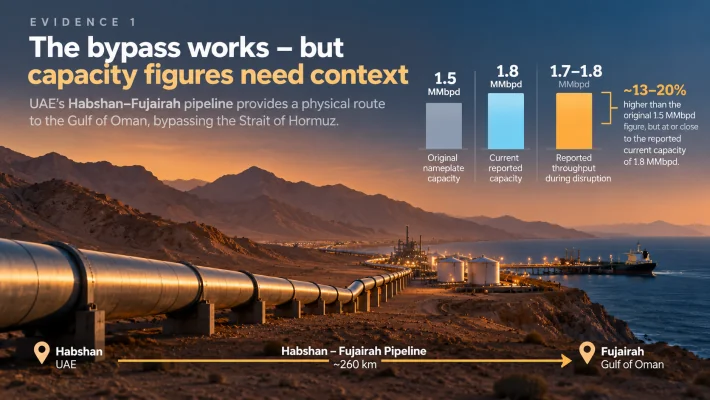
The UAE's Habshan-Fujairah pipeline provides a physical route to the Gulf of Oman, bypassing the Strait of Hormuz for crude transported through the system.
The International Energy Agency's February 2026 factsheet gives the line's original nameplate capacity as 1.5 million bpd and reports a current capacity close to 1.8 million bpd.
In May, Argus reported that the line was operating at approximately 1.7-1.8 million bpd.
The comparison is against the original 1.5 MMbpd nameplate figure. It does not establish operation above current capacity, nor does it demonstrate the sustainable throughput of the complete export chain.
The distinction matters. Publicly reported capacity figures describe different baselines. They do not establish that the pipeline is definitively operating above its current technical limit.
The more important engineering question is what the complete export system can sustain - and for how long.
The pipeline is only one element. Pumping capability, terminal throughput, storage availability, berth capacity and tanker scheduling all affect the volume that can actually reach the market.
The IEA also estimates that the UAE exports around 1.1 million bpd of domestic crude through this route, potentially leaving up to 700,000 bpd of additional capacity under its stated assumptions. That is a useful starting point for a contingency case, not proof that the entire export chain can sustain the same additional volume under every disruption scenario.
A pipeline's available capacity is not automatically the export system's available capacity.
Evidence 2: Storage buys time. It does not restore the route.
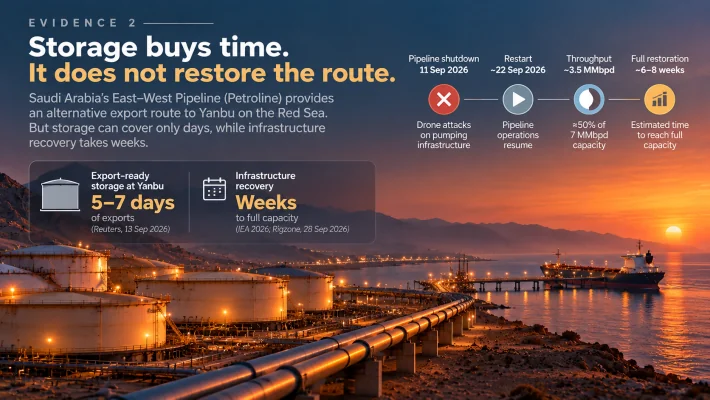
Saudi Arabia's East-West Pipeline, or Petroline, moves crude towards Yanbu on the Red Sea, providing an alternative to exports through Hormuz.
On 11 September, the pipeline was shut down following drone attacks on pumping infrastructure. Reuters reported that Saudi Arabia had only five to seven days of export-ready oil stored at Yanbu when the disruption occurred. The same report noted that repairs could take weeks.
The pipeline restarted around 22 September. But a restart is not the same as full restoration.
Reporting after the restart put flows at approximately 3.5 million bpd against a stated capacity of 7 million bpd - roughly half of that capacity. Restarting a pipeline and demonstrating sustained throughput under actual operating conditions are different milestones. See the Rigzone report on the resumption of exports.
The IEA's Hormuz factsheet adds another important qualification: around 2 million bpd of Petroline's capacity is associated with west-coast refinery demand, while sustainable flows at the increased 7 million bpd capacity had not been robustly tested.
These figures should not be treated as interchangeable. Pipeline design capacity, sustainable throughput, refinery supply and export capacity are different quantities.
For FEL, four milestones need to be separated:
- Pipeline restart - the system can move crude again.
- Export restart - cargo loadings at Yanbu resume.
- Throughput recovery - flows increase towards the required operating rate.
- Full restoration - the system returns to its required performance, including the availability of associated infrastructure.
These milestones do not necessarily occur at the same time.
The five-to-seven-day Yanbu figure is best understood as an export-ready inventory buffer under the conditions reported during the outage. It is not a universal measure of system autonomy. The usable buffer depends on the available stock, the export rate, refinery demand, terminal operations and the ability to load and dispatch cargoes.
The engineering implication is straightforward:
Days of storage and weeks of infrastructure recovery are different dimensions of resilience.
Storage can absorb a temporary interruption. It cannot compensate indefinitely for a route that remains unavailable or operates below the required rate.
Evidence 3: The UAE is building a second bypass. Kuwait has no equivalent route.
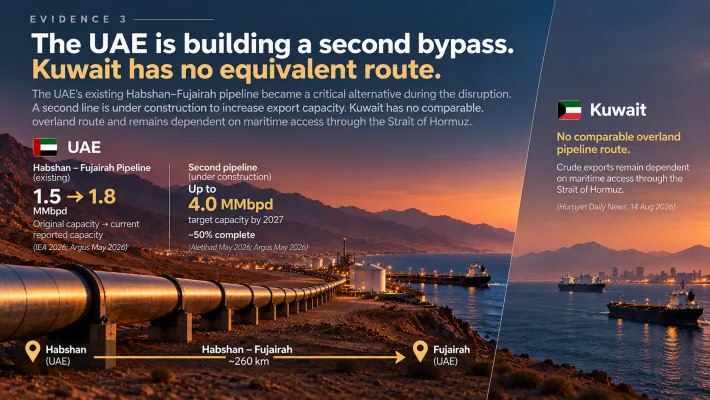
The UAE's existing Habshan-Fujairah pipeline became a critical alternative during the disruption. A second line is intended to increase the country's ability to export crude through Fujairah without relying on Hormuz.
In May 2026, ADNOC CEO Sultan Al Jaber said the second pipeline was approximately 50% complete, with delivery targeted for 2027. The project had been initiated in 2025 and was subsequently accelerated. Source: Aletihad.
Argus reported that the expansion is intended to double ADNOC's export capacity through Fujairah, potentially raising capacity to as much as 4 million bpd by 2027.
That is a significant infrastructure response. But additional pipeline capacity alone does not establish equivalent resilience across the whole chain. Terminal capacity, storage, loading facilities and vessel access must be able to support the higher rate.
Kuwait presents a different case. Unlike Saudi Arabia and the UAE, it has no comparable operational crude pipeline bypassing the Strait of Hormuz. Its crude exports remain dependent on maritime access through the strait. Source: Hurriyet Daily News, 14 August 2026.
The distinction is not simply between countries that have pipelines and those that do not. It is between export systems with different levels of route redundancy.
A second route may reduce exposure to a specific chokepoint. It does not eliminate every other failure mode, and it cannot provide redundancy for a country that has no equivalent route.
Evidence 4: A bypass still needs an outlet
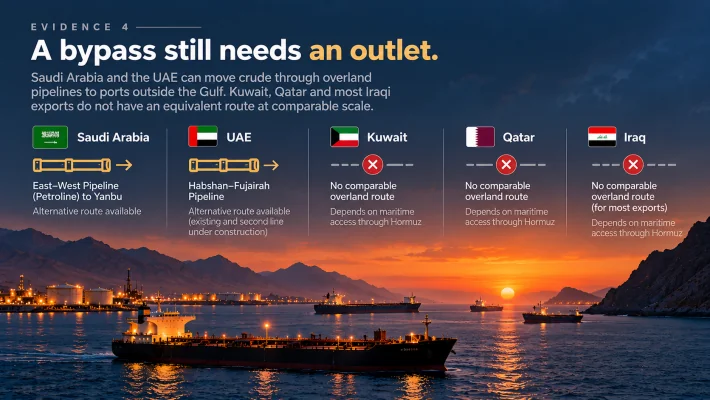
Saudi Arabia and the UAE can move crude through pipelines to ports outside the Gulf, reducing their dependence on the Strait of Hormuz. Kuwait, Qatar and most Iraqi exports lack a comparable operational alternative at the same scale.
Analysis from Kpler describes how Saudi crude moved west through Petroline to Yanbu and UAE crude moved east through Habshan-Fujairah to the Gulf of Oman. It also notes that Kuwait, Qatar and most of Iraq have no comparable route around the strait.
Where no suitable overland bypass exists, alternative arrangements may include shuttle tankers, ship-to-ship transfers and changes to loading or receiving arrangements. These measures can help maintain exports, but their effectiveness depends on vessel availability, transfer capacity, turnaround time and access to receiving tankers.
The same applies to a terminal. A pipeline's nominal throughput is of limited value if storage fills up, loading slots are unavailable or receiving vessels cannot be secured.
TThis is where the binding constraint can migrate. Once pipeline capacity is sufficient, the limiting factor may shift to terminal throughput, storage turnover, vessel availability, insurance conditions or shipowners' willingness to enter the area.
The October attacks demonstrate that security conditions can undermine the commercial usability of otherwise available infrastructure.
TThe available evidence does not quantify the export capacity lost specifically to vessel turnbacks. It does, however, demonstrate why infrastructure availability alone cannot establish deliverability. A route can be technically available but commercially unusable.
Evidence 5: LNG exposes the difference between production readiness and export readiness
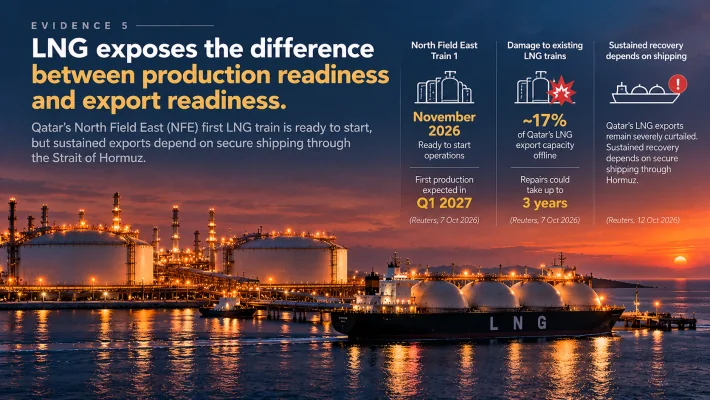
Qatar's North Field East (NFE) project illustrates the same issue through a different system.
On 7 October, Reuters reported that the first NFE LNG train was ready to start operations in November, with production expected in the first quarter of 2027. This was a planned start-up sequence, not confirmation of commercial LNG cargoes in November.
Separately, attacks on Ras Laffan damaged two LNG trains and a gas-to-liquids facility. Reuters reported that the damage had removed approximately 17% of Qatar's LNG export capacity and that repairs to the damaged LNG trains could take up to three years. Source: Reuters, 7 October 2026.
These are separate effects on deliverability: planned capacity additions do not offset existing capacity losses unless the new capacity is operational, supplied with feed gas and able to deliver cargoes to market.
Mechanical readiness, feed-gas availability and production ramp-up are necessary, but not sufficient, for sustained exports. Cargo delivery also depends on secure shipping access and the ability to reach customers.
Reuters' analysis of the regional LNG industry notes that Qatar's LNG exports remained severely curtailed and that sustained recovery depends on secure shipping through Hormuz. Source: Reuters, 12 October 2026.
For Qatar, there is no comparable overland export route that can replace LNG shipping through Hormuz at the same scale.
The distinction is between facility readiness and system deliverability: an LNG train may be ready to operate while shipping access or other parts of the export chain remain constrained.
What this means for FEL and concept development
These cases differ in infrastructure and operating context, but they expose a common weakness in early-phase project evaluation: export capacity is often treated as a fixed input rather than a system whose performance can degrade, stop and recover over time.
Four checks should be explicit before the concept is locked.
- Size redundancy against a denial scenario, not only a nameplate case.
A second route provides effective redundancy only if it can deliver the required volume while the primary route is unavailable. Test its sustainable throughput, operating constraints and performance over the credible outage duration. Two routes on a plot plan do not necessarily provide full redundancy.
- Treat storage as a time-dependent buffer.
Calculate how many days of export can be sustained at the required rate under defined inventory and operating assumptions. Then compare that buffer with the credible outage duration and restoration curve.
A storage figure without an associated demand rate and recovery scenario is not a resilience metric.
- Map every interface and identify single points of failure.
The export system includes more than pipelines and terminals. Pumping stations, power supply, loading berths, storage, transfer vessels, receiving tankers and access to shipping lanes can all become limiting elements.
The objective is not to label every component a risk. It is to identify which failure can stop or materially reduce delivery, and what recovery action is available.
- Model the outlet that the project does not control.
Shipping availability, insurance, transit restrictions and vessel risk appetite may sit outside the project boundary, but they can still constrain deliverable production and alter project cash flows and value.
Where these factors are material, they belong in the scenario analysis and economic model - not only in a qualitative risk register.
These checks should inform concept selection and the investment decision. A bypass that exists on paper may still fail to deliver the required rate if storage, terminal operations, vessel access or recovery time becomes the binding constraint.
The decision is not just how much to produce
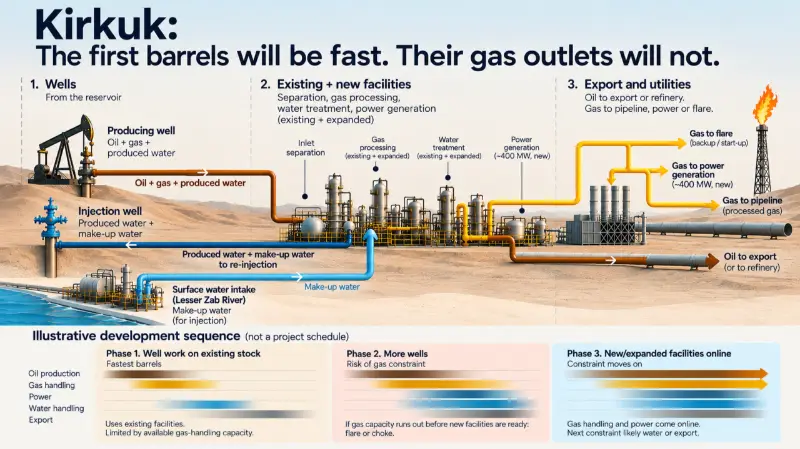
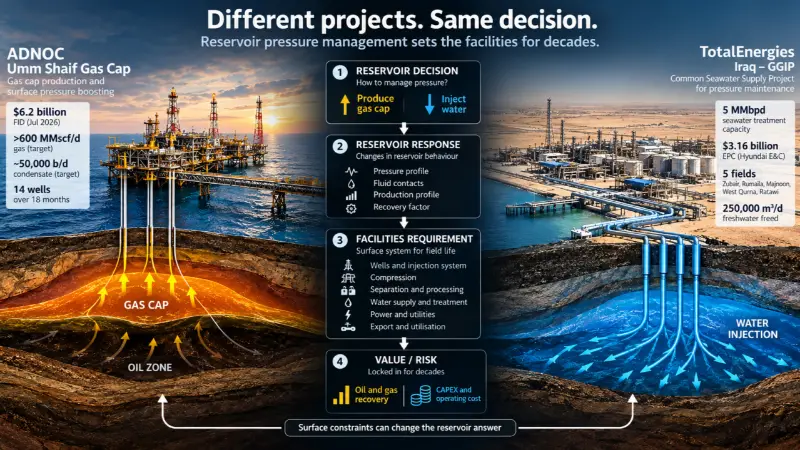
Kirkuk, Qatar's NFE start-up and Gulf crude export disruptions are different engineering cases, but they point to the same principle: technical potential, facility readiness and deliverable production are not interchangeable.
A reservoir may hold recoverable resources, a facility may be ready to operate, and a pipeline may be available - yet the complete system may still be unable to deliver the planned volume to market.
The FEL question is whether the complete system can deliver the required volume at the required time, sustain delivery through a credible disruption, and recover within an acceptable timeframe.
The bypass does not eliminate the constraint. It changes where the constraint sits.
If the concept defines the required export rate and storage volume, does it also demonstrate how long exports can be sustained during a route denial - and how long the system would take to recover?
#conceptengineering #FEL #Brownfield #ProjectDevelopment #EnergySecurity