Insights / Qatar · North Field
A Plateau Is a Staircase, Not a Step
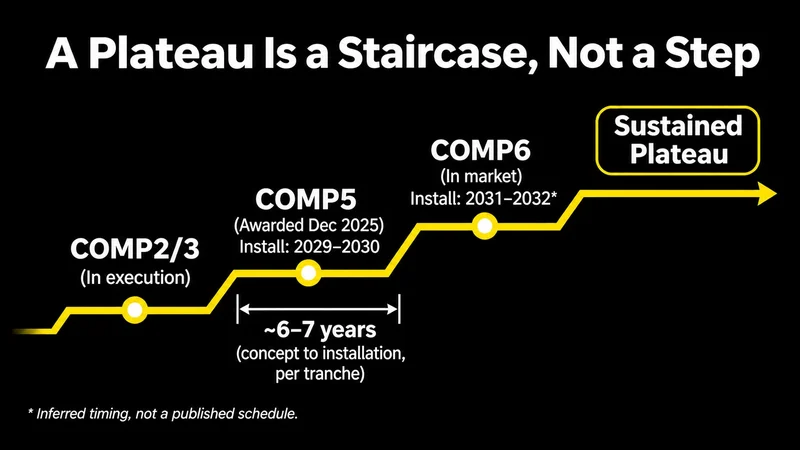
QatarEnergy's COMP6 is one more step in a programme of offshore compression. Each tranche takes six to seven years from concept decision to installation, and the binding constraint is now the installation window.
QatarEnergy LNG has opened pre-qualification for COMP6, an offshore compression package estimated at up to USD 4 billion.
The number in the name matters more than the number in the budget.
COMP2 and COMP3 are already in execution. COMP5 was awarded in December 2025. COMP6 is now in the market. On the world's largest gas field, holding plateau increasingly depends on a programme of offshore compression complexes, each one a multi-billion-dollar brownfield project in its own right.
That changes the question concept engineers should be asking. Not "do we need compression?" but "what does the whole staircase look like, and will each step land before the decline curve says it must?"
What was announced
COMP6 sits inside the North Field Production Sustainability (NFPS) programme. Its stated purpose is to add compression capacity to offset declining reservoir pressure and keep gas flowing from reservoirs that are already producing. Technip Energies won the FEED, reported as September 2026. QatarEnergy LNG has now opened contractor pre-qualification for the EPCI package. NFPS is planned in phases through 2032.
The previous step tells us what one tranche looks like. COMP5 went to Saipem and COOEC for about USD 4 billion in total, of which Saipem's share is about USD 3.1 billion. The scope is two compression complexes, each with a compression platform, a living quarters platform and a flare platform, connected by bridges. Each complex weighs about 68,000 tonnes. Offshore installation is expected in 2029 and 2030. Saipem also notes that COMP5 follows COMP2 and COMP3, which are in execution.
The pre-qualification for COMP6 screens contractors on heavy lifting, marine transport, structural integrity and installation sequencing.
Read that list again. Not reservoir characterisation. Not process design. Lifting and sequencing.
Where most coverage stops
Most coverage reads COMP6 as a contract race: who is shortlisted, who wins, what it is worth. That is a fair question for an EPC business development team, and the answer will matter to several large contractors in the region.
For anyone working at concept stage, the more useful reading is different. COMP6 is not a project. It is one more step on a staircase.
In an earlier article, I argued that pressure decisions are made in the reservoir and paid for in the facilities. The North Field shows the next stage of that logic. The bill is not one invoice. It is a schedule of invoices, and the schedule is set by physics you cannot negotiate with.
That distinction sounds academic until you see what it does to decision timing. A project has a start, an end and a sanction gate. A programme has a cadence, and if the cadence slips, plateau slips with it.
Why compression comes in waves
The mechanism is basic, which is exactly why it gets underweighted.
As reservoir pressure declines, flowing wellhead pressure declines with it. The export system downstream still needs gas at a fixed delivery pressure, because trunklines, onshore plants and LNG trains were designed around it. Compression closes the gap between what the wells can deliver and what the system needs. The gap grows every year the field produces.
You could, in theory, size one compression system for the end-of-life pressure ratio. In practice that machine is badly oversized for the early years. It recycles, burns fuel gas and ties up CAPEX years before it is needed. It also locks in assumptions about a decline curve you do not yet fully know.
Size it for the near term instead, and it runs out of ratio long before the field runs out of gas. Compressors have an operating envelope. When suction pressure falls below it, you re-wheel, add stages or add machines.
So mature gas fields add compression in tranches. Each step is sized and timed against the decline curve. Each step keeps optionality open as reservoir performance teaches you something new: how fast pressure actually falls, how water encroachment behaves, which wellhead clusters underperform.
On a field of this scale, with many wellhead platforms spread offshore, each tranche is also a physical complex in its own location, serving its own group of wells. The staircase is not only in time. It is in space as well.
That is a rational design. It is also a design whose success depends almost entirely on timing.
The next constraint is the installation window
Here is the part that changes how FEL should be run.
COMP5 was awarded in December 2025, with offshore installation in 2029 and 2030. That is roughly four to five years from award to installation, and FEED comes before the award. Add concept work before FEED, and the decision that delivers gas in a given year is made something like six to seven years earlier.
Now apply that to COMP6. FEED was reported in September 2026. If the award follows in 2027 and the cycle looks like COMP5, installation lands somewhere around 2031 to 2032. That is consistent with NFPS phasing to 2032, but it is my inference, not a published schedule. Signal, not proof.
The point stands either way. The compression needed to hold plateau in the early 2030s may have required concept decisions as early as the mid-2020s. The decision horizon is longer than the horizon over which most decline forecasts are comfortable.
And the next physical constraint is offshore logistics. A complex of around 68,000 tonnes needs heavy-lift capacity, marine transport, weather windows and a hook-up plan on a field that must keep producing throughout. Saipem names a single vessel, the De He, for COMP5 installation. Whatever vessel strategy COMP6 uses, the number of hulls that can set topsides of this size is small, and their calendars are shared across the region.
Pore pressure creates the need. But what limits delivering the next increment of compression on time is a crane, a vessel and a weather window.
This is constraint migration in its cleanest form. The reservoir sets the requirement. The facilities answer it. And the logistics of installing the facilities decide when the answer actually arrives.
What a staircase does to FEL
If plateau is a staircase, concept selection has to design the staircase, not the step. In practice that means four things.
1. Own the whole programme, not the next tranche. The concept should state how many tranches are expected over field life, what sizing logic links them, and which pressure or rate triggers each one. It should show which wellhead clusters each tranche serves and how the tranches share export routes. A study that sizes "the compression project" in isolation has answered the wrong question, however good its process design is.
2. Trigger backwards from lead time. The trigger is not "when wellhead pressure reaches X." It is "when the forecast says X will be reached, minus six to seven years." That turns uncertainty in the decline forecast directly into schedule risk. FEL should carry it as a range with a defined decision point, for example a P10 to P90 band on the trigger date and a rule for which edge of the band the programme commits to. A single date on a Gantt chart hides the most important assumption in the study.
3. Treat the marine spread as a design input. Installation vessel availability, lift weights, weather windows and the sequence across tranches belong in concept selection, not in the EPC execution plan. Topsides weight drives vessel choice. Vessel choice drives the season. If two tranches compete for the same heavy-lift season, the second one slips no matter how good its engineering is. At concept stage, a modest change in module split or lift strategy can be worth more schedule certainty than any amount of process optimisation.
4. Design for a live field. Every tranche ties into existing platforms and trunklines that are producing. Shutdown windows, SIMOPS, bridge connections and hook-up scope are brownfield interface work. They are where schedule quietly leaks, because nobody owns them as a deliverable until the EPC contractor finds them.
The failure mode I see most often in brownfield studies is the first one: compression framed as a project with a start and an end, when the reservoir has already made it a programme.
What goes wrong when the staircase is treated as a step
The failure modes are predictable, and each one has a cost signature.
Trigger too late. The decline curve arrives before the compression does. Plateau dips, and the lost volume is rarely recovered later because the next tranche is already on its own clock. On an LNG-linked field, a dip in feed gas is not only lost production. It is underutilised liquefaction capacity downstream.
Trigger too early. Compression is installed before the pressure ratio needs it. Machines run in recycle, fuel gas is burned for nothing, and capital is tied up years ahead of the volume it protects. Less dramatic than a plateau dip, but it shows up directly in unit cost.
Vessel and season clash. Two tranches, or a tranche and another operator's project, compete for the same installation window. Engineering is ready, fabrication is ready, and the topsides wait in the yard for a season.
Interface leakage. Each tranche is engineered well as a standalone complex, but the tie-ins, shutdowns and SIMOPS on the existing field are under-scoped. The cost appears late, as change orders and extended hook-up.
A simple test for any compression concept at FEL is to ask four questions. When must the next tranche be sanctioned, not when must it run? What decline uncertainty is that date carrying? Which installation season does it depend on? Who owns the tie-in scope? If the study cannot answer all four, it has designed a step.
Realisable value: where the staircase fits
I use a simple frame for early-phase decisions: Realisable Project Value = Economic Potential x Delivery Certainty.
On a field like the North Field, Economic Potential is the plateau volume and everything it feeds downstream. That term is large and well understood.
Delivery Certainty is whether each step of the staircase lands before the decline curve says it must. That term is set early, at concept stage, by trigger logic, lead-time realism and installation strategy. It is also the term that rarely makes the press release.
Plan one step at a time and you have planned to fall behind.
The pattern beyond Qatar
This is not unique to the North Field. Any mature gas field or gas cap feeding a fixed-pressure export system will reach the same point: deliverability stops being a reservoir question and becomes a facilities and logistics question.
Across the GCC, more gas production now comes from fields with long production histories, sour and deep gas developments, and gas caps that were once left untouched to support oil. Each of those will meet its own compression staircase. The details differ: onshore versus offshore, modular versus integrated, export pressure, fuel gas economics. The logic does not.
What makes the North Field instructive is scale and visibility. The staircase is public. You can watch the steps being bought in sequence, and you can read the pre-qualification criteria that point to the next factor limiting delivery time.
Where this argument has limits
The staircase view is strongest offshore, where each tranche is a heavy, integrated complex with long lead times. Onshore, with modular or skid-mounted compression, lead times are shorter and the penalty for a late trigger is smaller.
It also assumes pressure decline is the dominant driver. Where pressure is maintained by injection, or where the export pressure itself can be lowered, the trigger logic changes.
And I am reading the NFPS sequence from public sources. I do not have QatarEnergy's decline forecast, its trigger criteria or its vessel plan. The argument is about how to frame the decision, not a claim about how this particular programme is being run.
Calculation note
Lead time. COMP5: award Dec 2025, offshore installation 2029-2030 per Saipem, so about 4-5 years from award to installation. Adding FEED (around 1 year) and concept work (around 1 year) gives roughly 6-7 years from first concept decision to installed compression. Order-of-magnitude figures, not a schedule.
COMP6 projection. FEED reported Sept 2026 (single source), award assumed 2027, same award-to-installation cycle as COMP5, so installation around 2031-2032. Assumption-driven, plus or minus 1 year at least. Consistent with NFPS phasing through 2032 but not confirmed by QatarEnergy.
Scale of one tranche. COMP5: 2 complexes x about 68,000 t = about 136,000 t offshore, for about USD 4 billion total contract value, roughly USD 29,000 per tonne. Indicative only: the contract value covers engineering, procurement, fabrication and installation, not just steel.
Originally published on LinkedIn ↗
Working on a concept, Pre-FEED or a tender pack? A short call is often enough to see where the gaps are.