Insights / Framework · UAE / Iraq
Pressure decisions are made in the reservoir – and paid for in the facilities
Umm Shaif and southern Iraq's seawater project, two sides of the same FEL problem: who owns the pressure-maintenance decision between subsurface and facilities.
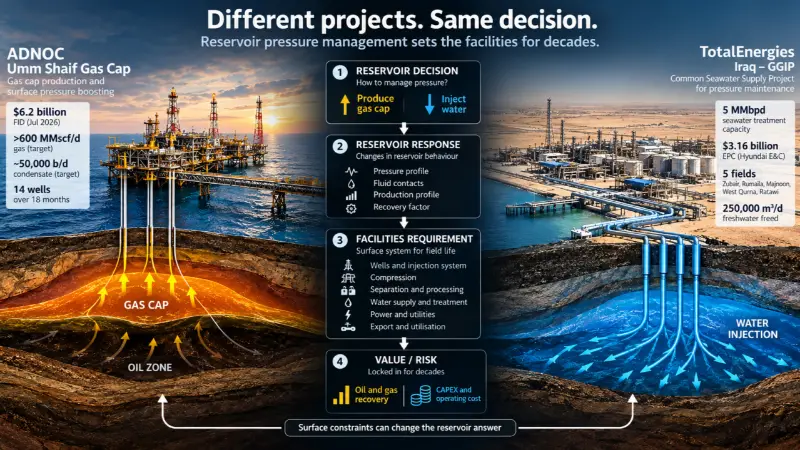
Two projects. Two different headlines. One FEL problem.
In July 2026 ADNOC Group took a $6.2 billion FID on the Umm Shaif Gas Cap. Ten months earlier TotalEnergies started construction of the Common Seawater Supply Project in southern Iraq, the last component of the $27 billion Gas Growth Integrated Project.
Different assets. Different fluids. Different facilities. Both start from the same question: how do we manage reservoir pressure over field life?
Umm Shaif shows that question in its familiar direction – a reservoir decision writing the surface architecture. Southern Iraq shows it in reverse – a surface constraint re-entering the reservoir decision. Read together, they describe one loop:
Reservoir strategy → facilities consequence → surface constraint → reservoir strategy revisited.
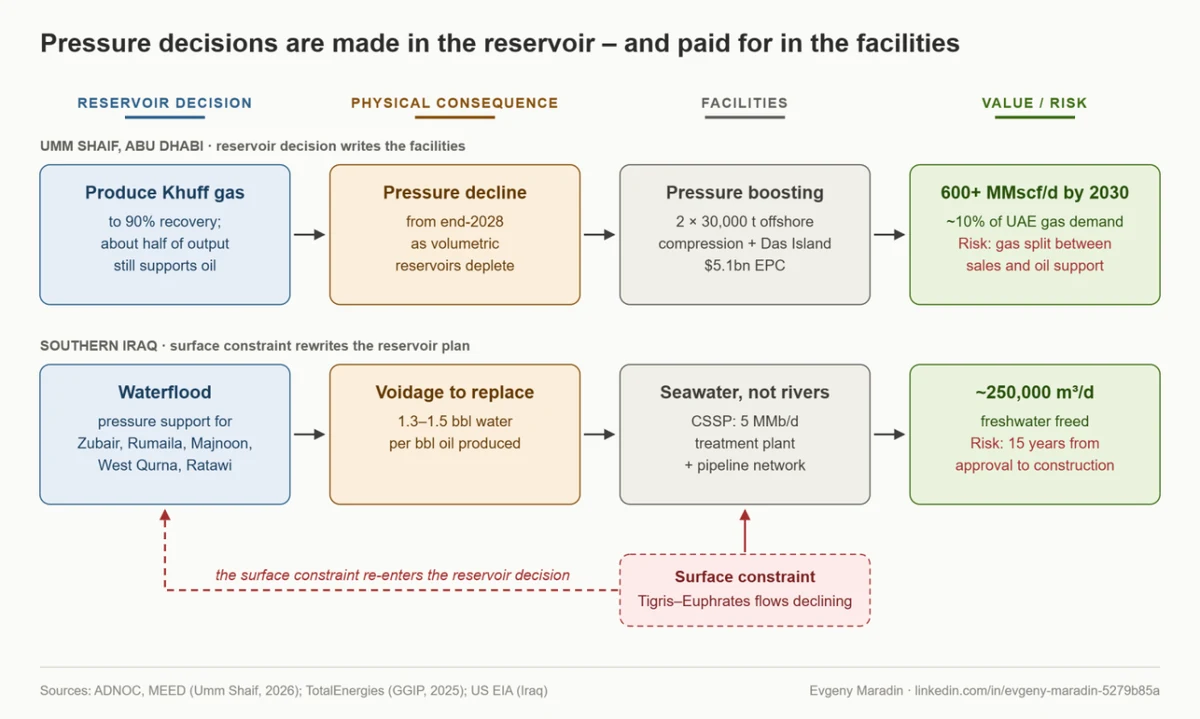
Concept selection works when that loop is closed inside one decision. It fails when the loop is cut into a handover from subsurface to facilities.
The forward arrow: Umm Shaif
The headline is gas: more than 600 MMscf/d by 2030, about 10% of current UAE demand, feeding ADNOC Group's target of 47 mtpa of LNG capacity by 2035.
The engineering underneath is pressure. The Umm Shaif Khuff reservoirs are dry-gas volumetric reservoirs, producing since 1989. About half of current well output is injected to support the oil reservoirs of the same field. And Khuff pressure is expected to start declining by the end of 2028, which is why the project needs surface pressure boosting to hold plateau and reach a 90% gas recovery target.
Follow the chain:
- Reservoir decision: produce the Khuff gas to 90% recovery.
- Physical consequence: a volumetric reservoir loses pressure as it depletes.
- Facilities: two 30,000-tonne offshore compression systems and an onshore package at Das Island – $5.1 billion of EPC.
- Value and risk: plateau and recovery on one side; on the other, how the gas is split between sales and oil-reservoir support.
A gas-cap decision is not isolated from oil recovery. It changes the pressure-management problem of the whole field, and with it the surface requirements.
The field has answered this question before. In 2002 Worley was awarded FEED for an Umm Shaif gas reinjection project – compression and processing platforms to put gas back into the reservoir. In 2024 Worley did the FEED again, this time for producing the gas and boosting its pressure. Same field, same question, answered again two decades later under different constraints. The pressure-maintenance decision is never made once.
The reverse arrow: southern Iraq
Iraq's southern fields generally need 1.3 to 1.5 barrels of injected water for every barrel of oil. The reservoir answer – waterflood for pressure support – was never in dispute. The water was.
In April 2010 a senior oil ministry official named ExxonMobil to lead a 10–12 million b/d water-injection scheme for the newly awarded southern fields, because Tigris and Euphrates flows were already declining. Here a surface constraint became part of the pressure-maintenance decision: how much each field could inject, how fast, and from what source depended on water that no reservoir model controls.
The answer on paper was seawater. Execution took fifteen years. The Iraqi Cabinet approved the scheme in September 2010, and FEED and pre-FEED contracts were placed the same year. ExxonMobil lost the lead role in 2012, amid Baghdad's dispute over its Kurdistan contracts. CH2M came in as project management consultant and ILF took the pipeline FEED in 2014. The original concept – 12.5 million b/d, around $13 billion, 426 km of pipeline – was cut back to a 5 million b/d first phase. ExxonMobil walked away again in June 2018, when MEES warned that Iraq's 6.5 million b/d target for 2022 looked unachievable without CSSP. Hyundai E&C was selected in 2019. None of it reached construction.
The US EIA lists the causes of the slippage: management changes, administrative delays, contract disagreements, financial hurdles. None of them is subsurface. None of them is facilities engineering – front-end engineering was done more than once. It was an ownership gap: a common facility serving several field operators, and no single party with the authority to freeze the concept, fund it and hold the interface with every field it was meant to feed.
GGIP closed that gap structurally: one operator, one integrated package. Construction started in September 2025, roughly two years after the GGIP effective date. The plant will treat 5 million b/d of seawater for Zubair, Rumaila, Majnoon, West Qurna and Ratawi and free up to 250,000 m³/day of freshwater now drawn from the Tigris, the Euphrates and aquifers.
When the loop closes – and when it does not
The region has closed this loop before. When Aramco's Qurayyah seawater plant started in 1978, treated seawater replaced water drawn from onshore aquifers for Ghawar injection, and by 1979 the plant was delivering 4.2 million b/d. It can now process 14 million b/d. The surface constraint – finite aquifer water – was built into the reservoir strategy, not discovered after it.
Kuwait closed it another way at Greater Burgan. The Wara pressure maintenance project collects and treats effluent water and injects up to 1 million b/d into the Wara formation, through 20 storage tanks, 60 pumps and a 700 km pipeline network. A surface problem – produced water – became the pressure-support source.
The North Sea and the Caspian show the price of an open loop. At Ekofisk, depletion of a compressible chalk reservoir took the seabed down with it: by December 1984 the water depth had increased by three metres, and in 1987 eight platforms were jacked up by about six metres. Subsidence was one of the reasons the complex was rebuilt as Ekofisk II in 1998. At Kashagan the fluid was well characterised – extreme H2S – yet around 200 km of pipeline failed from sulphide stress cracking within weeks of first oil in September 2013, and commercial output did not resume until November 2016.
Different failures, same class of miss: the subsurface signal was known, and it did not reach the facilities basis with enough authority to change it.
What the integrator has to own
Rule one – model pressure across the P10–P90 band, not at P50. The pressure trajectory drives the surface concept as much as the production profile does. Test each concept at P10 (does it still work?) and P90 (does it strand capital?). If a concept only works at P50, it is an assumption, not a concept.
Rule two – cost the interface, not the equipment. At Umm Shaif the visible number is $5.1 billion of EPC. The less visible numbers are the timing of compression against the pressure decline and the value of gas injected for oil support versus gas sold. In southern Iraq the less visible number was time: years of injection water taken from rivers and aquifers while the seawater plant waited for an owner. These numbers belong in the NPV, not in a footnote.
Rule three – own the assumptions, red-team the concept, and treat No-Go as a duty. The integrator does not need to out-argue the reservoir engineer on physics or the cost engineer on rates. The integrator needs ownership of one document: a Master Assumptions Register holding every input the concept depends on – pressure case and P-level, profile vintage, injection source, tie-in and shutdown windows, price deck, estimate class. One version, one owner, every discipline signing its own rows. When injection is sized on P90 and compression on P50, the mismatch shows in a single line, and the gate does not open until it is resolved.
Before each gate, run a cross-discipline Red Team with the people already on the project: operations challenges the facilities basis, facilities challenges the subsurface handover, economics challenges both. No consultants, no external review budget – a documented sign-off that every basis has been attacked by someone who does not own it. Then score the result: PDRI rates definition from 0 to 1000, and projects at 200 or below outperform those above it; the IPA FEL Index grades the same gate from Inadequate to Best Practical.
When the register is inconsistent or a Red Team finding is still open, recommending No-Go or Pause is not obstruction. It is the integrator's fiduciary duty to the shareholders and JV partners whose capital the gate commits.
One loop, two directions
Umm Shaif shows a reservoir decision writing the facilities. Southern Iraq shows a surface constraint rewriting the reservoir plan – and what it costs when nobody owns the rewrite.
Pressure decisions are made in the reservoir – and paid for in the facilities.
In your last concept study – was the pressure-maintenance strategy chosen by the subsurface team and handed to facilities, or did the two decide it together?