Insights / Digital
Oilfield Development System: Bridging Engineering and Digital Intelligence
Lessons from building a digital oilfield MVP that linked SmartField data, PETEX GAP models and GIS with field systems.
Perspectives and Lessons Learned from a Digital Oilfield Journey
Developing a niche software product — even when the direction is trendy — is always a challenge. It requires patience, engineering discipline, and strong collaboration between technology and operations.
In 2019–2020, while working at Salym Petroleum Development, I participated in one of the key directions of the company’s Integrated Intelligent Field Architecture (IIFA) digitalization program — the development of the Oilfield Development System (ODS), led by Denis Tokarev.
⚙️ ODS as Part of the IIFA Ecosystem
The IIFA program aimed to create a unified digital management loop for upstream assets — from well clusters to the oil treatment unit. Its main goal was to integrate engineering models, real-time production data, and mathematical simulations into a single digital platform — enabling predictive operations and holistic asset understanding.
By that time, Salym Petroleum Development already had a Smart Field system (implemented jointly with Shell) — an efficient operational tool but with limited visualization and engagement beyond the daily operational teams. In parallel, several high-quality subsystem models already existed:
- Pipeline networks (Petex)
- Surface facilities (Unisim),
- Power supply systems (Energy CS),
- Reservoir and wells (various tools with forecasting in Serafim Future),
- Project management through SAP,
- Document control via ASSAI web (planned migration to SAP).
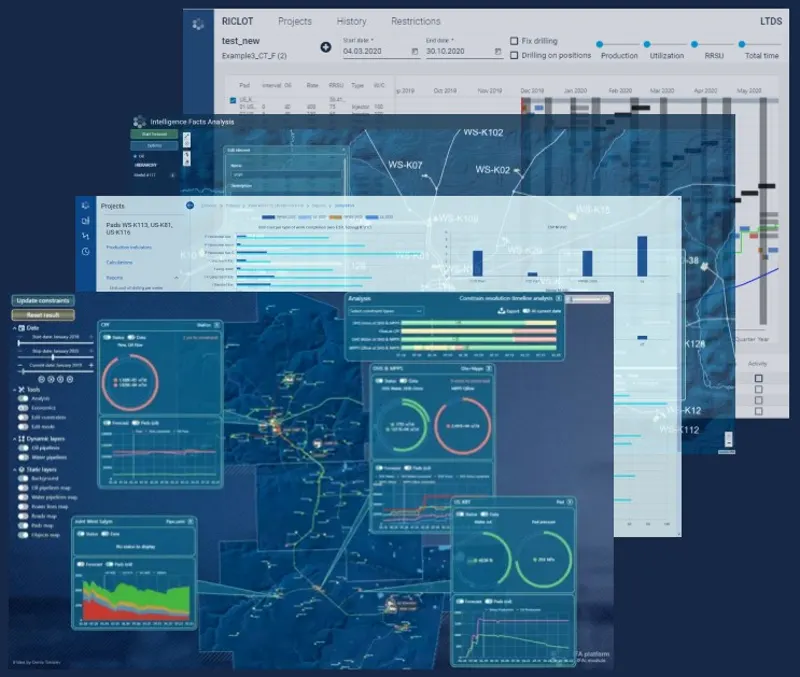
On this solid base, ODS — whose core engineering layer was built within the IIFA framework — was designed to model surface facilities, simulate technological processes, and consolidate investment and planning data.
The vision was to digitally reproduce the entire asset structure, model dynamic flows and physical interactions between elements — from well clusters to the central processing facilities.
🧩 Three Core Functional Blocks
The functional architecture of ODS included three interconnected components:
- Data Aggregation Block – consolidated data from measurement and monitoring systems into a unified, reliable calculation base.
- Visualization Block – provided an interactive asset map with object-level performance indicators.
- Mathematical Modeling Block – integrated optimizers and algorithms to simulate behavior and forecast system performance.
👷 My Role in the Project
At the initial stage, I was responsible for designing the logic and algorithms for modeling surface facilities — defining the relationships between technological units, process flows, and infrastructure elements. Later, I took part in testing alpha and beta versions, evaluating the accuracy of simulations, visualization quality, and integration with other IIFA modules.
The main IT contractor was Novosibirsk Scientific and Technical Center (NNTC) — a leading Russian developer specializing in digital modeling of industrial systems.
🚀 Results and Further Development
The ODS system was successfully migrated from desktop to a web-based environment, and its MVP version became the Digital Twin demo of Salym Petroleum Development assets. This allowed engineers to try analyze system behavior in real time, perform scenario-based calculations, and make data-driven decisions.
Later, due to reduced project funding (COVID-19 period) within Salym Petroleum Development , further development and adaptation of ODS continued in another Gazprom Neft , where it evolved into an Enterprise Project Management (EPM) platform. Today, the system’s principles are applied in ROSPAN and NOVATEK — a solid confirmation of its technological value and adaptability.
💡 Key Lessons Learned
🔹 Funding vs. Expectations: Ambitious goals often exceeded available resources. Balanced scope definition and incremental delivery are crucial for maintaining team motivation and stakeholder trust.
🔹 Iterative Development is Essential: Trying to implement everything at once risks delaying the MVP. Breaking development into small, meaningful releases ensures progress and visibility.
🔹 Front-End Must Keep Pace with the Core: Delays in UI development can undermine product perception — synchronized development streams are key to stakeholder confidence.
🔹 Dedicated Participation from the Client Side: Client experts should be allocated at least 0.75 FTE to ensure effective knowledge transfer. Enthusiasm is not a sustainable substitute for structured engagement.
🔹 Agile Mindset is Crucial: Many participants were new to Agile and Scrum, which affected sprint discipline. Shorter sprints with tangible deliverables improve communication and alignment.
🔹 True Win-Win Collaboration: Both client and contractor must contribute proportionally — in expertise, funding, and strategic focus — to realize equal benefits.
🔹 Involve Knowledge Carriers Early: The presence of experienced engineers and domain experts in early design stages ensures the system truly reflects field realities.
🌍 Final Thought
ODS became more than just a digital prototype — it was a bridge between engineering thinking and digital intelligence. Its development journey proved that even within limited resources, a shared vision, cross-disciplinary teamwork, and belief in innovation can transform how we understand and manage oilfield systems.
#OilAndGas #DigitalOilfield #OilfieldTransformation #SalymPetroleum #Shell #Gazpromneft #PIVision #ProcessEngineering #DOF #conceptengineering #SurfaceFacilities #Petex #DigitalTwin #honeywell #epm #DataAnalysis #DataScience #MVP #Product #ProductDevelopment #Scrum #Agile