Insights / Iraq · Kirkuk
Kirkuk: The First Barrels Will Be Fast. Their Gas Outlets Will Not.
Kirkuk is going from 320,000 to 420,000 bpd. The first barrels come quickly from existing wells, but the outlets for their gas take years. The real question is sequencing.
Kirkuk is targeting 420,000 barrels per day, up from 320,000. ConocoPhillips (42%) and TPAO (15%) are set to join BP (43%) in the vehicle behind the redevelopment once the announced deals close, and remuneration is tied to incremental production, prices and costs.
The resource is not in doubt. Kirkuk was discovered in 1927.
The question is sequencing. At a mature field, the fastest early barrels are likely to come from the existing well stock. The additional gas, power and water-handling capacity behind those barrels needs new or expanded facilities, and those take longer to deliver.
Kirkuk’s real development schedule may be set by the gap between well work and gas-handling capacity. The size of that gap depends on one number that is not public: spare capacity in the existing North Gas Company plants.
This is a sequel to my article “Pressure Decisions Are Made in the Reservoir - and Paid For in the Facilities”.
What is public, and what is not
In August, Iraq’s Oil Ministry set out the targets: crude from 320,000 to a peak of 420,000 bpd, and associated gas from 255 to 400 MMscf/d. The scope also includes a 400 MW power plant and an end to routine flaring. Other figures have come from different speakers at different times: 450,000 bpd from the then deputy oil minister in late 2025, and up to 500,000 bpd from the then Oil Minister in January 2025. I use the Ministry’s latest.
The contract covers a drilling programme, rehabilitation of existing wells and facilities, and new infrastructure including gas expansion, across oil, gas, power and water. A new operator, staffed mainly by North Oil Company and North Gas Company personnel with BP secondees, is to take over from NOC.
What is not public: well counts, rig plans, a facility list, the power plant site and technology, a water balance and a schedule. What follows is a FEL reading of the public scope, not inside knowledge.
The fast part: wells
Before handover, NOC reactivated idle wells at Bai Hassan and connected new ones, and upgraded the pipeline network on the Avana Dome. BP’s preliminary plan includes 3D seismic.
That points to a familiar sequence: work the existing well stock first, then drill new wells once the seismic is in. Restarting idle wells, workovers, sidetracks, acid or hydraulic fracturing and infill wells all add oil through gathering and treating facilities that already exist. In my experience, that kind of well work delivers barrels within months. A drilling campaign shaped by new seismic takes years.
At a waterflooded field, the bigger lever is often the production mix. Choking back or shutting in the wettest wells, and bringing on or opening up wells with a lower water cut, adds oil without adding liquid throughput. Swap 10,000 barrels per day of liquid at 90% water cut for the same liquid at 50%, and oil rises from 1,000 to 5,000 barrels per day through the same separators, pumps and water-handling plant.
That relieves the water side. It does not relieve the gas side. Every barrel brings its gas with it, from day one, and at a domed field, wells with a lower water cut often sit higher on structure, where the gas-oil ratio tends to be higher. Water can be managed by choosing which wells to produce. Gas, much less so.
The slow part: outlets
Gas. The planned increase on the gas-handling side is materially larger than the oil increase: 57% versus 31%. Public reporting describes the 255 and 400 MMscf/d figures both as gas production and as processing capacity, so I treat them as a gas-handling target, not measured output. On the Ministry’s figures, that is about 800 scf per barrel today and about 1,450 scf per incremental barrel. Part of the increment may be gas flared today: official data from early 2024 put wellhead gas at about 400 MMscf/d, of which about 300 was captured. Part may be rising gas-oil ratio in depleted domes. Either way, it needs gathering, compression and treating capacity, existing or new.
The gas is sour. North Gas Company reports up to 125 tonnes of sulphur per day across its operations, and a stockpile above 600,000 tonnes. More sour gas means more sulphur, through an outlet that already looks constrained.
Power. A 400 MW gas-fired plant at full load burns roughly 65 to 95 MMscf/d, equivalent to half to two thirds of the incremental gas. No site, technology or contract award is public.
Water. Kirkuk has been under waterflood since 1961, and the injection water historically came from a river rather than the subsurface. Before that, gas from Bai Hassan was injected as a temporary measure. By 1965, injection averaged about 1.2 million barrels per day. The province’s main river is the Lesser Zab, which fills the Dokan reservoir upstream. Which surface source feeds injection today, and how much, is not public.
If surface water still matters, the issue is not its average flow but its swings. In June 2025, Dokan fell to about 24% of capacity, its lowest level in roughly 20 years, and Kirkuk’s water treatment plants faced a 40% drop in supply. By late March 2026, after heavy rains, Dokan was close to 60% full. An injection system for a multi-decade redevelopment has to be designed for the dry years, and in a dry year the oil field competes with drinking water and irrigation.
Produced water is the other side. In 2013, NOC contracted an effluent water treatment and injection plant at Bai Hassan. Local reporting describes oily water accumulating southwest of Kirkuk and puts current injection above one million barrels per day. How much of that is reinjected produced water is not public.
That makes water a balance question, not a source question: what share of future injection can produced water cover, and how much external make-up water is still needed? More oil means more voidage to replace. If the make-up share stays large, injection depends on surface water whose availability swings from year to year. If reinjection covers most of it, the scope shifts to treating oily, sour water: removing oil and solids, controlling H2S corrosion, and keeping it compatible with formation water to avoid scaling. Water is in the contract scope, but no water balance is public.
Export. A one-year interim agreement for the Iraq-Türkiye pipeline covers 750,000 bpd, against flows of about 180,000 bpd in July. Here the capacity is there; the certainty is not, because the legal framework now runs one year at a time.
My estimate, not a public figure: a sour gas processing expansion typically needs three to four years from investment decision to start-up, and a gas turbine power plant two to three years from award.
The gap
An illustrative sequence, not a project schedule:
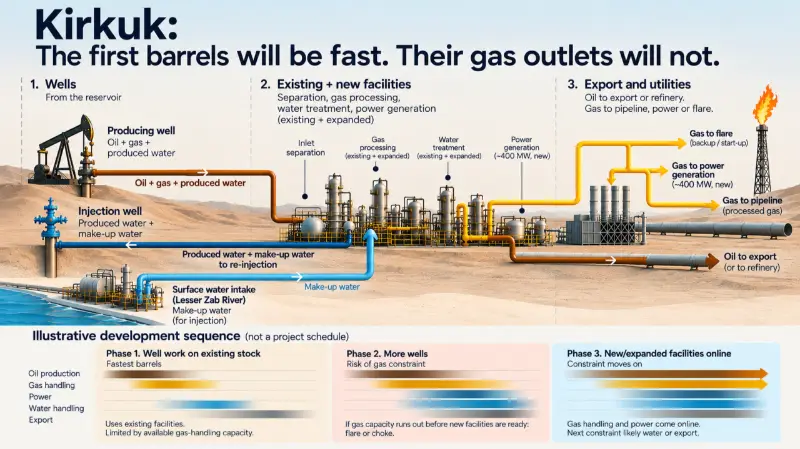
Phase 1. Well work on the existing stock and a better production mix add oil within existing liquid capacity. The gas comes with it, and goes into whatever spare capacity the existing NGC plants have.
Phase 2. More wells come on. If spare capacity runs out before new facilities are ready, the gas has two remaining destinations: the flare, which conflicts with Iraq’s target to end flaring by early 2029, or the choke, which keeps oil in the ground.
Phase 3. Expanded gas handling and the power plant come online. The constraint moves on, and water is the most likely next candidate: injection depends on surface water with volatile availability and on produced-water handling that is not public.
The constraint at Kirkuk is not only a place in the system. It is a date. Before designing the new gas plant, I would establish how much of the early ramp-up the existing system can absorb. That single number decides whether Phase 2 exists at all.
Why it decides the economics
Remuneration follows incremental production. A choked barrel is a lost fee. A flared cubic foot runs against the government’s core objective for the project. If gas handling lags, the operator has no good option, only a choice of which cost to carry. Who carries it at the NOC-NGC interface is not public.
I describe Realisable Project Value as Economic Potential × Delivery Certainty. At Kirkuk, the resource sets the first term. The timing of the gas and water outlets sets the second.
The organisation matters too. Oil facilities sit with NOC, gas plants with NGC, and remuneration with a vehicle paid on incremental oil. When BP withdrew staff in March, NOC took operating responsibility for four of the fields by decree for a year; BP has since been back at the joint management committee. I worked inside a Shell joint venture where seconded and local teams shared one asset. Decision rights at the interface between organisations set schedules as much as the interface between pipes.
A smaller version of the same problem
In the early 2010s, I led the surface facilities workstream of a concept for an ageing oil-rim field with a large gas cap. A compressor station framed as a gas utilisation project turned out to be the future source of lift gas. It competed for capital and was commissioned years later, by which time the gas profile had moved, and the station was ultimately sized to the gas profile that remained.
The engineering logic held. Timing changed the design.
Six questions a partner entering now should ask
- How does the +100,000 bpd split between work on existing wells, production-mix changes and new drilling, year by year?
- How much spare capacity is in existing NGC trains, and at what sulphur rate?
- How much of the +145 MMscf/d is flare capture, and how much is gas-oil ratio growth?
- Does the power plant start up before or after the oil ramp-up?
- Who holds decision rights at the NOC-NGC interface, and who carries the cost of choked barrels?
- What share of future injection will produced water cover, and where does the make-up water come from?
None of these are reservoir questions. All of them decide how many of the 100,000 barrels arrive, and when.
The pattern
At Kirkuk, the question is not where the bottleneck sits, but when each part of the system becomes the bottleneck. Production targets are set in barrels. Delivery is set by the sequence in which barrels and their outlets arrive.
For those who have worked mature-field redevelopments: what arrived first in your project, the barrels or the outlets?
If you are working on Kirkuk or a similar redevelopment and want an independent concept-stage view of the surface system: [email protected]
Calculation note
- Oil: 320 → 420 kbpd = +100 kbpd (+31%).
- Gas: 255 → 400 MMscf/d = +145 MMscf/d (+57%). Gas per barrel: 255 ÷ 320 ≈ 800 scf/bbl; incremental: 145 ÷ 100 ≈ 1,450 scf/bbl. Sources describe 255 and 400 MMscf/d both as production and as processing capacity; the ratio indicates gas-handling burden, not measured GOR.
- Production mix: 10,000 bpd liquid × (1 - 0.90) = 1,000 bpd oil; × (1 - 0.50) = 5,000 bpd oil. Illustrative, not field data.
- Power fuel: 400 MW × 7,000 to 10,000 Btu/kWh at ~1,000 Btu/scf, full load = 67 to 96 MMscf/d (±25%; technology and load factor not public). Build durations: author’s estimate from comparable projects, not project data. NGC sulphur and dry gas figures are company-wide, not contract-area figures.
#oilandgas #upstream #FEL #brownfield #Iraq