Insights / Iraq · White paper
Iraq's next upstream cycle
A white paper on brownfield redevelopment, infrastructure constraints and why program integration, not individual projects, decides value in Iraq's new cycle.
1. Why Iraq is entering a new investment cycle
Strategic Context
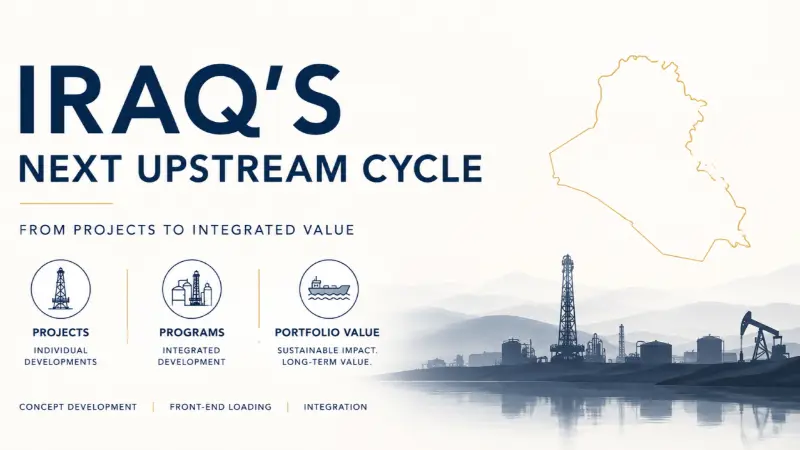
Iraq is entering one of the most important upstream investment cycles since the first international licensing rounds in 2009-2010. Unlike previous periods, the current wave of investment is not driven solely by increasing crude oil production. It combines brownfield redevelopment, associated gas monetization, modernization of aging infrastructure and expansion of export capacity into a broader transformation of the national upstream sector. Earlier development phases largely focused on maximizing field production. Today's objective is to improve the performance of the entire production system while increasing long-term recovery, reducing routine flaring and strengthening domestic energy security.
- Redevelopment of mature supergiant fields
- Expansion of associated gas gathering and processing
- Modernization of surface facilities
- Improvement of water injection systems
- Diversification of export infrastructure
Iraq's Resource Base Creates Opportunity - Not Success
According to the Energy Institute Statistical Review, OPEC Annual Statistical Bulletin and the Iraq Ministry of Oil, Iraq holds approximately 145 billion barrels of proven oil reserves and around 130 Tcf of natural gas resources. Current production averages approximately 4.2–4.3 MMbpd, with a government ambition to expand capacity beyond 6 MMbpd by 2029.
A New Generation of Upstream Investments
- bp redevelopment of the Kirkuk producing area
- Halliburton Integrated Field Management for Bin Omar and Sindbad
- KBR, Inc. Integrated Field Management Services and strategic pipeline studies
- Expansion of associated gas gathering and processing
Gas Is Becoming a Strategic Asset
According to the World Bank Global Gas Flaring Tracker, Iraq continues to flare approximately 17–18 bcm/year while still importing gas for power generation. Gas infrastructure is therefore becoming a strategic component of upstream value creation.
Why This Cycle Is Fundamentally Different
- Production growth must be supported by gas, water and export infrastructure
- Brownfield redevelopment requires integration with existing facilities
- Investment decisions increasingly influence portfolio performance
Executive Implications
- Resource size is no longer the principal differentiator
- Infrastructure readiness increasingly governs production growth
- Gas monetization is becoming central to upstream economics
- Early integration decisions have portfolio-wide consequences
Interim Takeaway
Iraq's next upstream cycle represents a transition toward integrated portfolio development, where long-term success depends on synchronizing reservoirs, infrastructure, gas utilization and capital investment from the earliest stages of project definition.
2. Iraq is rebuilding an integrated production system
Strategic Context
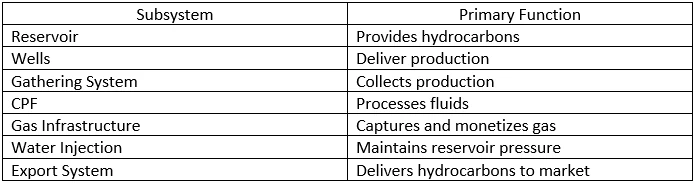
Iraq's future production performance will depend not only on reservoir quality but on the ability to synchronize every element of the production system. Reservoirs, wells, gathering systems, processing facilities, gas infrastructure, water injection and export routes operate as one integrated system. Optimizing one subsystem does not guarantee optimal field performance if another subsystem becomes the limiting constraint.
From Assets to Systems
Traditional project development often optimized individual assets. Modern brownfield redevelopment requires optimization of the complete production system, balancing technical performance, investment timing and operational flexibility.
- Reservoir performance drives production potential.
- Wells provide production capacity.
- Surface facilities process hydrocarbons.
- Gas systems sustain oil development.
- Water systems preserve reservoir pressure.
- Export infrastructure converts production into revenue.
Constraint Migration
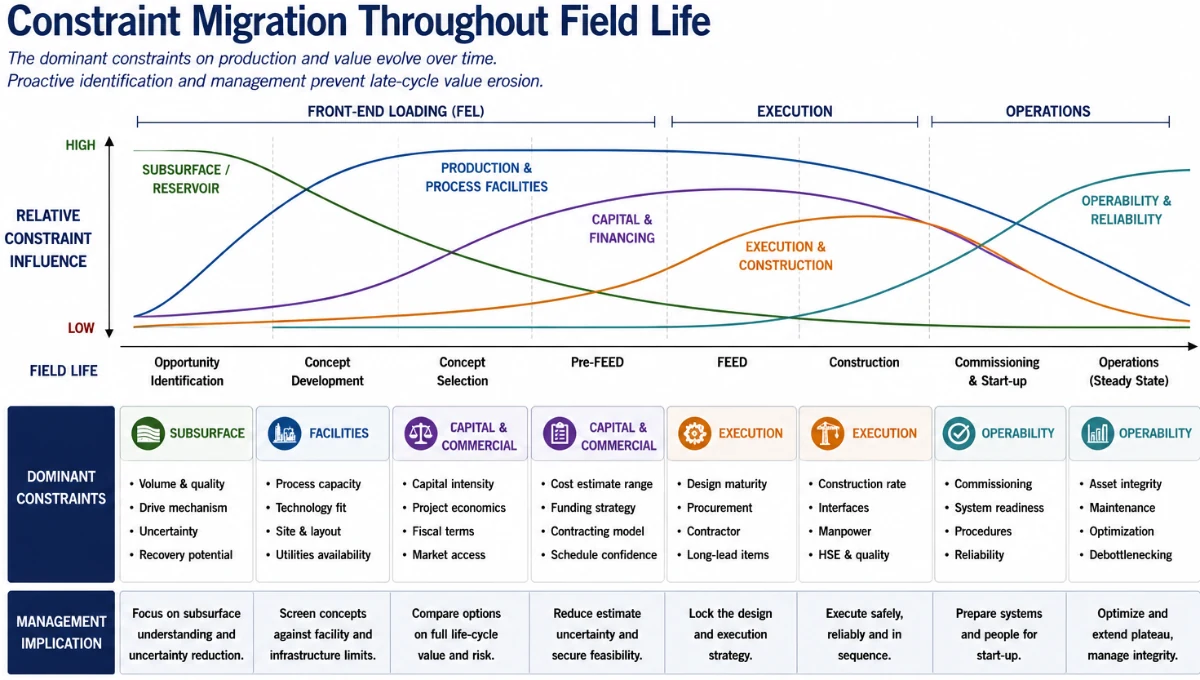
Production constraints evolve throughout field life. During early development they are often associated with drilling and facilities. As production grows, bottlenecks typically migrate toward gas handling, water management, export capacity and ultimately reservoir deliverability. Successful Concept Development anticipates this migration rather than reacting to it.
Synchronization Creates Value
Integrated development is fundamentally an exercise in synchronization. Infrastructure commissioned too early creates idle capital. Infrastructure delivered too late defers production and reduces portfolio value. The objective is therefore to align technical readiness, construction sequencing and capital deployment.
Table 2. Integrated Production System
Executive Implications
As development portfolios expand, engineering decisions increasingly influence portfolio performance rather than individual project outcomes. Program Integration becomes the mechanism that aligns subsystems before constraints reduce production.
- Production is limited by the weakest subsystem.
- Synchronization is more valuable than local optimization.
- Early integration reduces future bottlenecks.
- System thinking should begin during FEL.
Interim Takeaway
An oil field should be managed as an integrated production system rather than a collection of independent facilities. The objective of Concept Development is to synchronize technical systems before constraints become irreversible.
3. Western companies are returning - but to different constraints
Strategic Context
Recent agreements involving international companies are often interpreted as isolated commercial opportunities. In reality, they address different constraints within Iraq's integrated production system. The strategic significance lies not in the companies themselves but in the capabilities they bring to reservoir redevelopment, infrastructure modernization and production integration.
International Participation
Iraq's renewed engagement with international operators and contractors reflects a broader shift toward integrated brownfield redevelopment. Different organizations contribute to different parts of the value chain, collectively strengthening the production system rather than individual facilities.
Table 3. Companies and Strategic Roles

Technology Is Not Enough
Advanced engineering, digital tools and modern equipment improve execution, but they do not eliminate system constraints on their own. Production performance depends on how effectively new capabilities are integrated with existing reservoirs, facilities, gas infrastructure and export systems.
- Technology improves subsystem performance.
- Integration improves system performance.
- Portfolio value depends on synchronization rather than isolated optimization.
The Missing Integrator
As the number of operators, contractors and stakeholders increases, interface complexity grows. The critical capability is no longer delivering individual projects but coordinating technical, commercial and execution decisions across multiple organizations. This is where Program Integration creates value.
Executive Implications
For decision makers, the strategic question is not which company has secured the next contract. It is whether the combined portfolio of projects removes the constraints limiting production growth.
- Projects should be evaluated as part of one production system.
- Interfaces deserve the same attention as engineering scope.
- Program Integration should begin during FEL.
- Successful portfolios synchronize capabilities across organizations.
Interim Takeaway
International participation should be viewed as a portfolio of complementary capabilities rather than a series of independent contracts. Sustainable production growth depends on how effectively these capabilities are integrated into one development program.
4. Program integration: the new production constraint
Strategic Context
Large upstream portfolios no longer succeed simply because individual projects are delivered on time and within budget. Production growth depends on how effectively wells, facilities, gas infrastructure, water injection, utilities and export systems are synchronized. Program Integration has therefore become a strategic capability rather than an administrative coordination function.
Projects Deliver Assets. Programs Deliver Value
Projects deliver individual assets such as production facilities, pipelines or drilling campaigns. Programs create value only when these assets become operational in the required sequence and function as one integrated production system. Optimizing project performance does not necessarily optimize portfolio performance.
Table 4. Project Management vs Program Integration

Every Investment Creates Dependencies
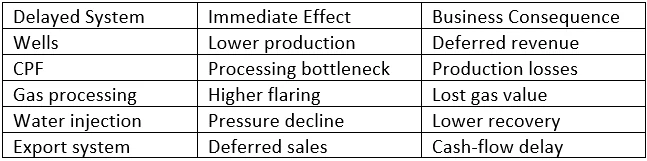
No major upstream investment remains isolated. Increasing production requires coordinated expansion of gathering systems, processing facilities, gas infrastructure, water injection, utilities and export capacity. A delay in one subsystem propagates across the entire production chain.
Table 5. Dependency Examples
Integration Creates Economic Value
Synchronization improves more than operational performance. It accelerates cash flow, reduces idle capital, lowers peak annual CAPEX, improves infrastructure utilization and reduces interface risk. The highest-value development strategy is therefore rarely the fastest. It is the best synchronized.
- Synchronize technical readiness.
- Align investment timing.
- Coordinate construction sequencing.
- Integrate commissioning and start-up.
- Manage dependencies before execution.
Program Integration Begins During FEL
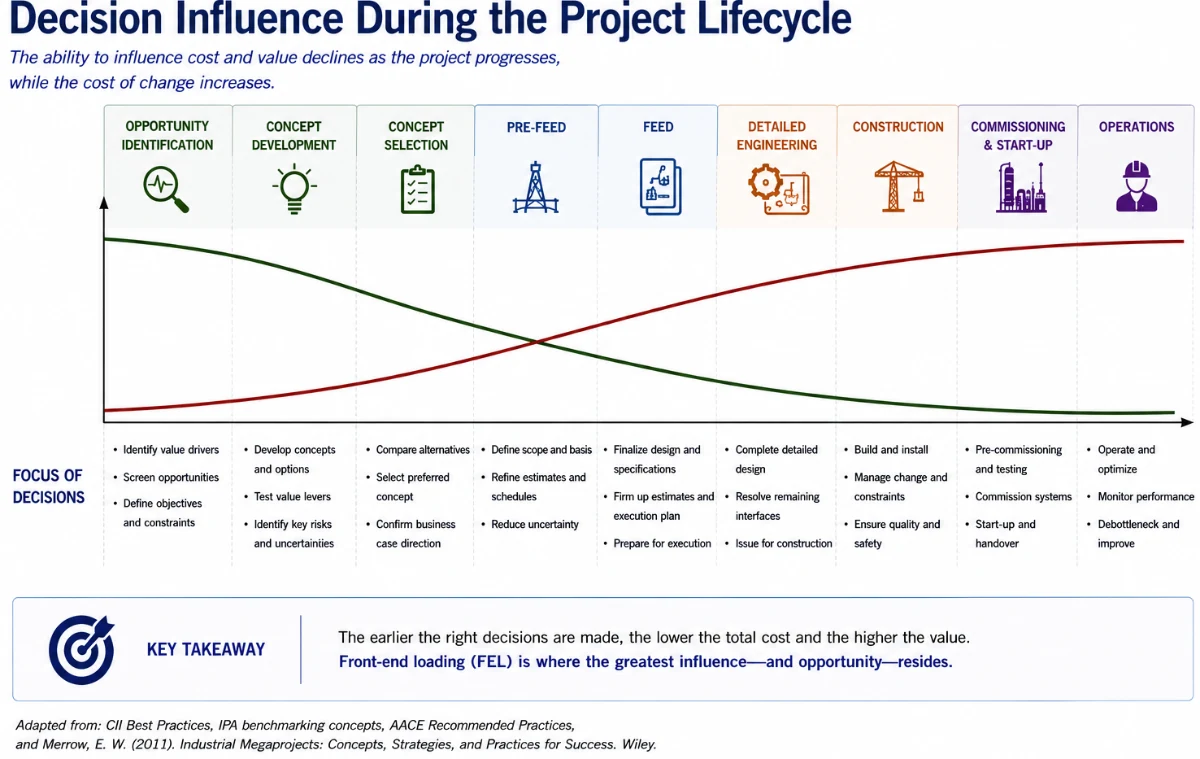
Most strategic decisions are made before FEED. During FEL1 and FEL2, development concepts remain flexible and dependencies can still be managed at relatively low cost. Once projects enter detailed engineering and execution, opportunities to improve system integration decline rapidly.
Executive Implications
Program Integration is becoming the mechanism through which engineering capability is converted into sustainable production, cash flow and long-term portfolio value. Organizations that optimize systems rather than projects will be better positioned to execute increasingly complex upstream portfolios.
Key implications:
- Think beyond project boundaries.
- Prioritize dependencies as well as deliverables.
- Evaluate portfolio value, not only project value.
- Embed Program Integration during FEL.
Interim Takeaway
Program Integration is no longer a coordination activity. It is becoming the principal discipline through which technical, commercial and execution decisions are synchronized to maximize long-term portfolio performance.
5. Five strategic constraints
Strategic Context
Future production growth in Iraq will depend on how effectively multiple constraints are managed simultaneously. Modern upstream programs no longer fail because of a single technical issue; they underperform when interacting constraints are not recognized early during Concept Development.
1. Gas Infrastructure
Associated gas gathering and processing must expand in parallel with oil production. Without sufficient gas capacity, flaring increases and future oil growth becomes constrained.
2. Water Management
Pressure maintenance through water treatment and injection is essential for mature fields. Delays reduce recovery, shorten plateau production and increase operating costs.
3. Execution Capacity
Engineering resources, EPC contractors, drilling rigs and long-lead equipment are increasingly shared across competing regional projects, creating schedule risk.
4. Organizational Complexity
Multiple operators, contractors and regulators increase interface complexity. Governance and decision quality become as important as engineering execution.
5. Capital Allocation
Capital must be deployed when technical readiness creates value. Poor sequencing produces idle assets or deferred production.
Table 6. Iraq's Principal Strategic Constraints

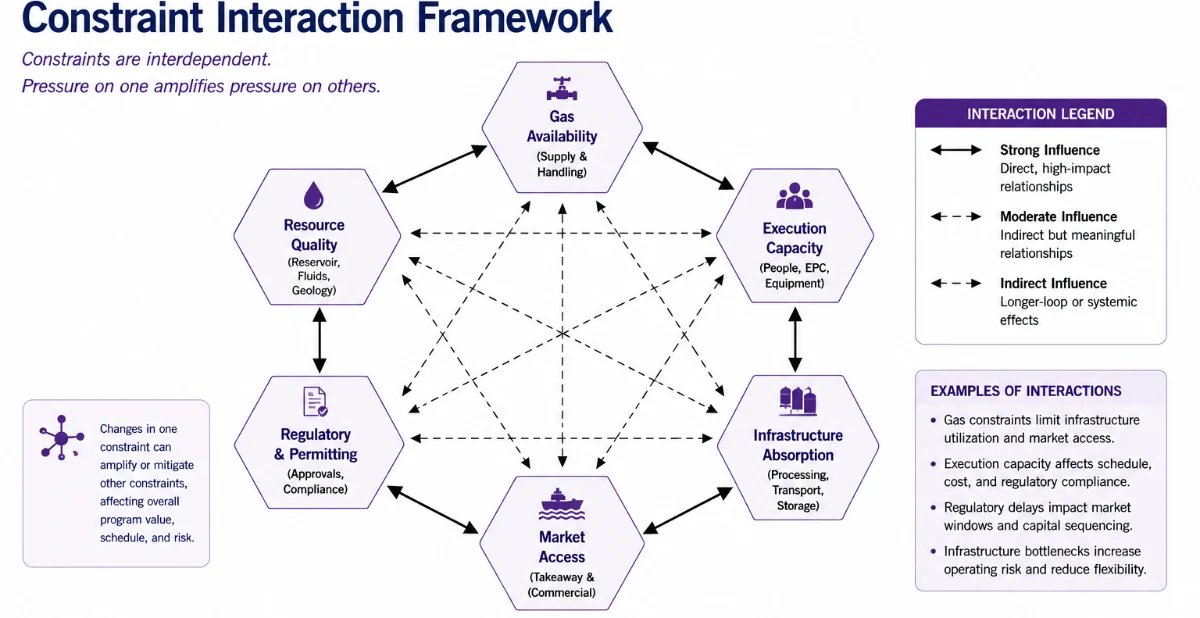
Constraints Do Not Operate Independently
These constraints reinforce one another. Delays in gas infrastructure affect production and cash flow, deferred cash flow influences future investment, and postponed investment delays water systems and additional production capacity. Successful programs therefore manage interactions rather than isolated issues.
Executive Implications
- Manage constraints as one integrated system.
- Prioritize synchronization over local optimization.
- Align engineering, capital and execution decisions.
- Identify bottlenecks during FEL1–FEL2.
Interim Takeaway
The principal challenge is not removing a single constraint but maintaining synchronization as constraints evolve throughout the field life cycle. Program Integration provides the framework for balancing technical, commercial and organizational priorities.
6. Beyond NPV: why capital timing has become a strategic variable
Strategic Context
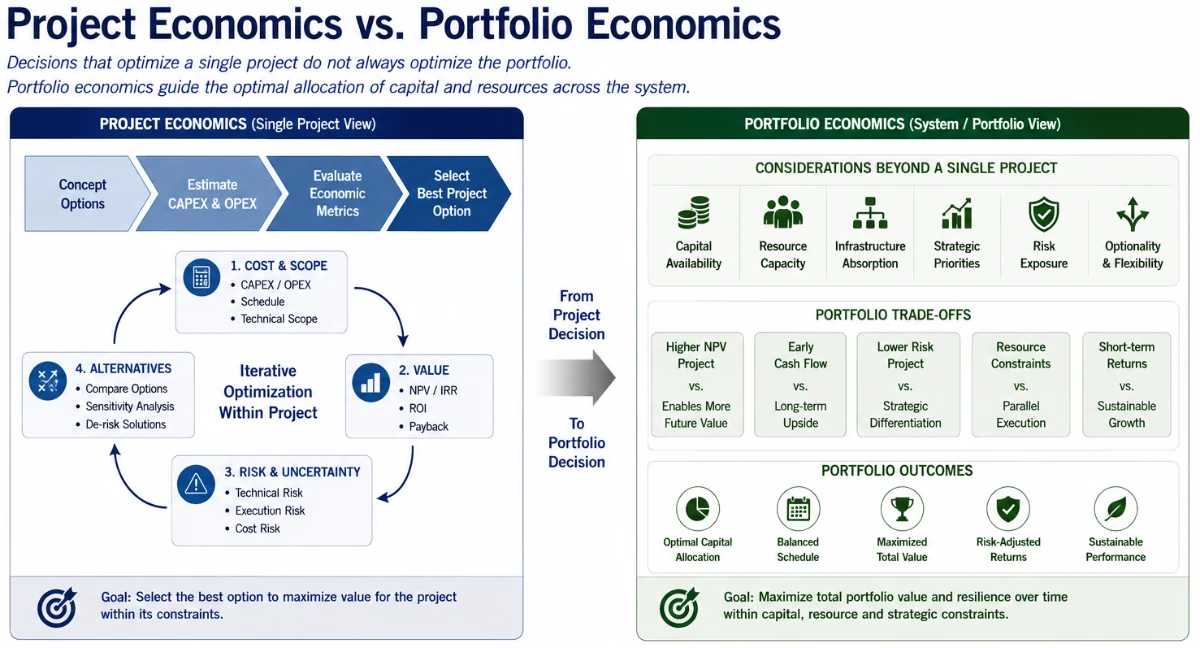
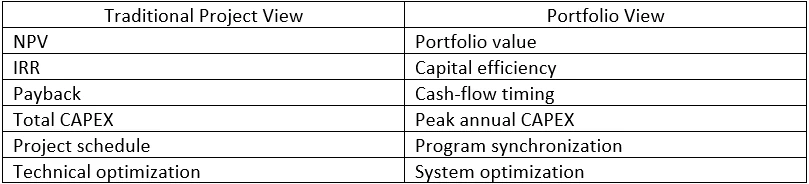
Traditional upstream investment decisions have long been driven by NPV, IRR and payback period. While these metrics remain essential, they no longer capture the complexity of large integrated development programs. Capital allocation must now balance technical readiness, execution capacity and portfolio-wide dependencies.
The Best Project Does Not Always Receive Funding
A technically attractive project may still be deferred if it competes for engineering resources, exceeds annual capital limits or creates pressure on shared infrastructure. Investment committees increasingly optimize portfolios rather than individual projects.
- Annual CAPEX constraints.
- Cash-flow stability.
- Execution capacity.
- Infrastructure readiness.
- Corporate investment priorities.
Peak Annual CAPEX Matters More Than Total CAPEX
Two projects with identical total CAPEX may require very different annual funding profiles. Excessive peak spending can delay other strategic investments, reduce financial flexibility and increase execution risk. Effective phasing smooths capital deployment while maintaining production objectives.
Capital Should Follow System Readiness
Capital invested before infrastructure is ready creates idle assets. Capital invested too late defers production and delays cash flow. The objective is not maximizing expenditure but aligning investment with technical readiness across the production system.
Table 7. Project Economics vs Portfolio Economics
Optionality Creates Long-Term Value
Phased development preserves flexibility to respond to changing production performance, market conditions and infrastructure availability. Concepts that maintain future options often outperform concepts optimized for a single forecast.
Executive Implications
Capital allocation is becoming an engineering decision as much as a financial one. Development sequencing increasingly determines production timing, infrastructure utilization and long-term portfolio performance.
- Evaluate projects within the portfolio context.
- Optimize peak annual CAPEX.
- Synchronize investment with technical readiness.
- Treat optionality as a design objective.
Interim Takeaway
The defining question is no longer which project delivers the highest standalone NPV. It is which sequence of investments creates the greatest long-term portfolio value through effective Program Integration.
Chapter 7. Why FEL Will Matter More Than Ever
Strategic Context
As upstream portfolios become larger and more interconnected, the greatest opportunity to influence project value shifts toward the earliest stages of development. By the time projects enter FEED, most strategic decisions on production strategy, facility sizing, infrastructure configuration and capital deployment have already been made.
Most Value Is Created Before FEED
Engineering effort increases throughout the project lifecycle while the ability to influence outcomes steadily declines. During FEL1–FEL2, development concepts remain flexible, allowing teams to optimize infrastructure, evaluate alternatives and manage dependencies before execution begins.
FEL Aligns Four Decision Domains
Modern Front-End Loading aligns technical, commercial, execution and portfolio decisions rather than engineering alone.
- Technical – reservoir, facilities, gas and water systems.
- Commercial – CAPEX, cash flow and investment timing.
- Execution – procurement, construction and commissioning.
- Portfolio – shared infrastructure, interfaces and capital allocation.
The Study Manager Becomes a System Integrator
The role of the Study Manager extends beyond concept selection. Modern concept studies evaluate infrastructure readiness, execution sequencing, dependency management, capital timing and long-term flexibility to maximize portfolio value rather than optimizing individual disciplines.
Table 8. Traditional FEL vs Integrated FEL

Decision Quality Determines Portfolio Performance
Projects rarely underperform because engineers cannot design facilities. More often, value is lost because critical decisions are made before system interactions are fully understood. Strong Front-End Loading improves decision quality while major choices remain reversible.
Executive Implications
Front-End Loading has become the principal opportunity to synchronize engineering, economics and execution before detailed engineering begins.
- Protect decision flexibility during FEL.
- Evaluate concepts at system level.
- Integrate technical and commercial decisions.
- Use FEL to reduce future constraints.
Interim Takeaway
FEL is no longer simply the first phase of project development. It is the stage where production strategy, capital allocation and Program Integration converge to determine long-term portfolio performance.
Chapter 8. Scenarios to 2030
Strategic Context
Iraq's ambition to expand production capacity beyond 6 MMbpd depends less on geology than on execution quality. Future performance will be determined by the synchronization of reservoirs, infrastructure, capital allocation and organizational capability rather than production targets alone.
Three Development Scenarios
Scenario analysis provides a practical framework for assessing how different combinations of market conditions, investment timing and execution quality could influence long-term production performance.
Integrated Growth
Conditions
Supportive oil prices, synchronized infrastructure, stable investment and effective Program Integration.
Expected Outcome
Production approaches 6 MMbpd, gas utilization improves significantly and portfolio value is maximized.
Controlled Expansion
Conditions
Moderate prices, localized delays and generally coordinated infrastructure development.
Expected Outcome
Production reaches approximately 5.0–5.3 MMbpd with gradual improvements in gas utilization.
Fragmented Development
Conditions
Lower investment, infrastructure delays, EPC constraints and higher geopolitical uncertainty.
Expected Outcome
Production stabilizes around 4.4–4.7 MMbpd with lower capital efficiency and continued flaring.
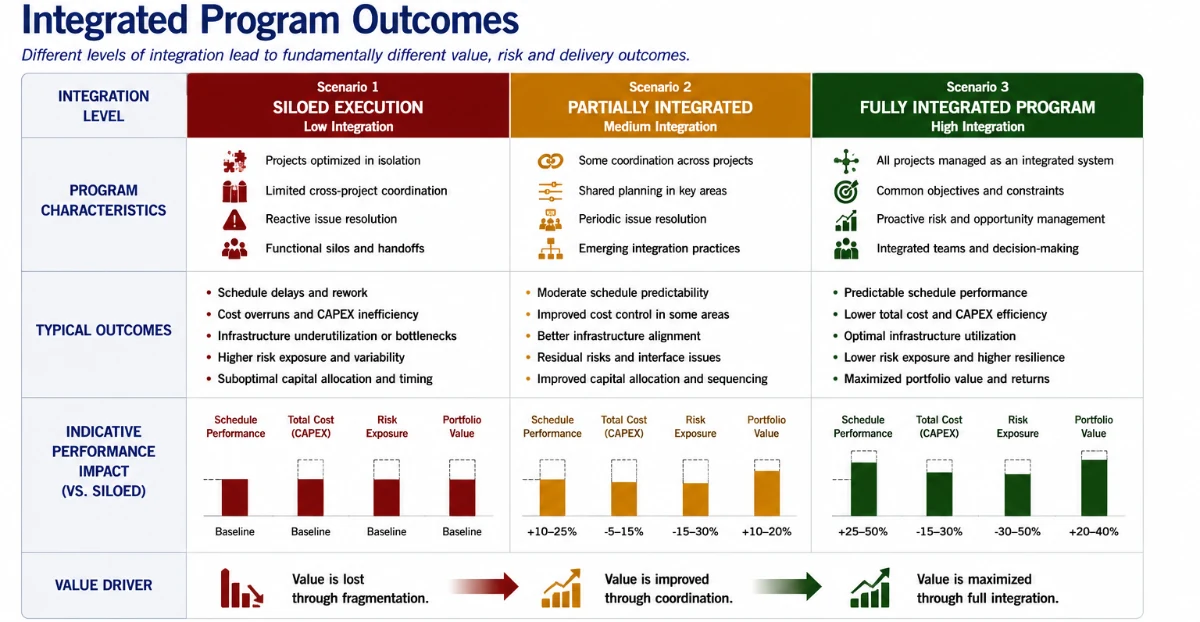
Table 9. Scenario Comparison

The Real Risk Is Loss of Synchronization
The principal uncertainty across all scenarios is not resource availability but the ability to coordinate production growth, gas infrastructure, water management, export capacity and capital deployment. Even technically successful projects may underperform if these elements evolve out of sequence.
Executive Implications
- Evaluate scenarios at portfolio level.
- Monitor infrastructure readiness as closely as production forecasts.
- Treat synchronization as a strategic KPI.
- Review development sequencing continuously.
Interim Takeaway
Iraq's future production will ultimately depend on the quality of Program Integration established during Concept Development and Front-End Loading rather than on resource potential alone.
Executive Conclusions
Five Strategic Findings
1. Iraq's primary constraint is no longer geology. Future production growth will depend increasingly on infrastructure readiness, execution quality and system synchronization rather than resource availability.
2. Program Integration has become a production discipline. Reservoirs, wells, facilities, gas processing, water injection and export systems create value only when they operate as one synchronized production system.
3. Capital allocation is becoming an engineering decision. Development sequencing, peak annual CAPEX and infrastructure readiness increasingly influence portfolio performance alongside traditional economic metrics.
4. FEL creates value by improving decisions. The greatest opportunity to influence production, cost and schedule exists while concepts remain flexible during FEL1-FEL2.
5. The Study Manager is evolving into a system integrator. Future concept development requires balancing technical, commercial, execution and portfolio objectives rather than optimizing individual engineering disciplines.

Questions for Decision Makers
- Which subsystem is most likely to become the governing production constraint?
- Are oil, gas, water and export systems synchronized with the planned production profile?
- Does the investment maximize project value or portfolio value?
- Which dependencies could delay production even if individual projects succeed?
- Has Program Integration been embedded during FEL1–FEL2?
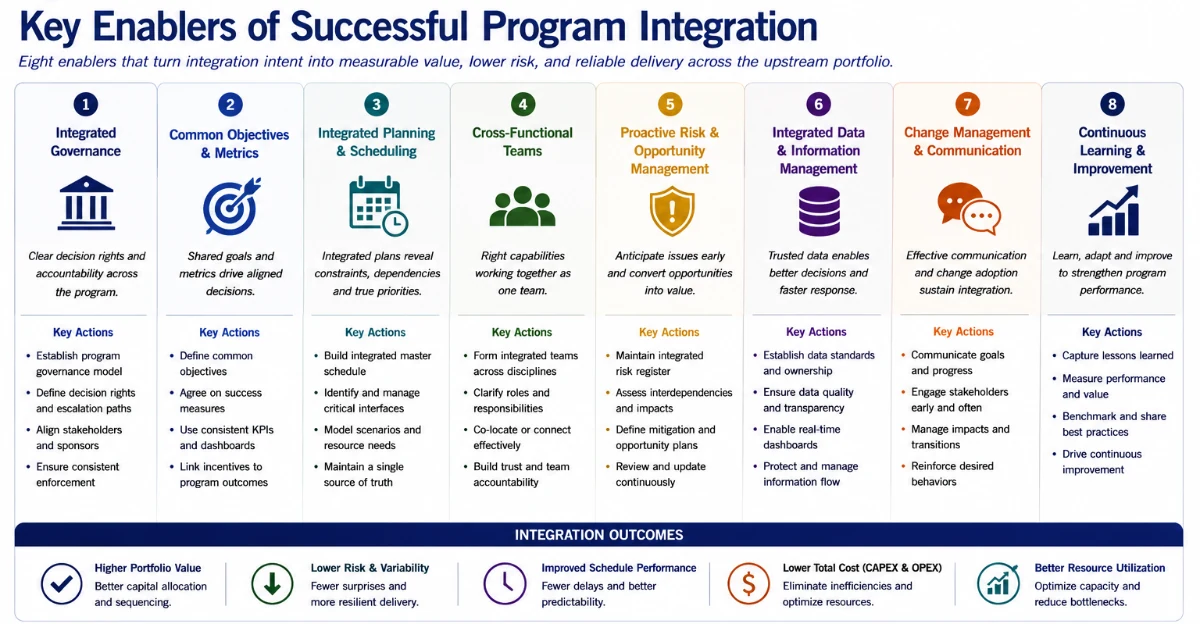
Key Messages for Executives
- Resources alone do not create production.
- Projects alone do not create value.
- Infrastructure alone does not eliminate constraints.
- Program Integration determines portfolio performance.
- The greatest value is created while decisions remain reversible.
Appendix A. Major Iraq Upstream Projects (2024–2026)
This appendix summarizes major publicly announced upstream developments that illustrate the transition toward integrated field redevelopment, gas monetization and infrastructure expansion. The table is intended as a strategic overview rather than a complete inventory of Iraqi upstream projects.
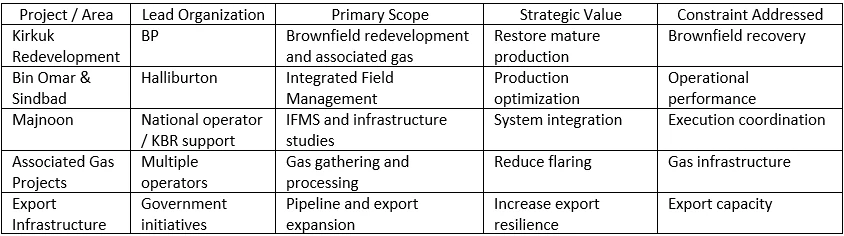
Strategic Observation
Viewed individually, these initiatives address different technical challenges. Viewed collectively, they represent complementary investments across one integrated production system, reinforcing the central argument developed throughout this paper.
Appendix B. Program Integration Checklist
This appendix consolidates key publicly available indicators referenced throughout the paper. The values are indicative and should be updated periodically as new official statistics become available.
Technical Readiness
- Align reservoir deliverability with production strategy.
- Confirm facility sizing.
- Integrate gas gathering and processing.
- Confirm water injection requirements.
- Evaluate export constraints.
Commercial Readiness
- Test multiple economic scenarios.
- Evaluate peak annual CAPEX.
- Assess cash-flow timing.
- Compare portfolio value with project NPV.
Execution Readiness
- Identify long-lead equipment.
- Confirm engineering and EPC capacity.
- Validate construction sequence.
- Map commissioning dependencies.
Portfolio Integration
- Identify shared infrastructure.
- Define project interfaces.
- Document dependencies.
- Embed Program Integration governance.
Executive Decision Gate
- Confirm no critical bottlenecks remain.
- Maintain concept flexibility.
- Align with corporate priorities.
- Review residual risks.
Checklist Outcome
Progress to the next decision gate only when technical, commercial, execution and portfolio considerations have been assessed as one integrated system.