Insights / Oman
Oman’s 2026 Onshore Licensing Round: Five Blocks, Three Failed Campaigns, and What It Means for Front‑End Engineering
Block-by-block history, the brownfield-adjacent versus greenfield split, and what it means for FEL scope and the timing of front-end hiring.
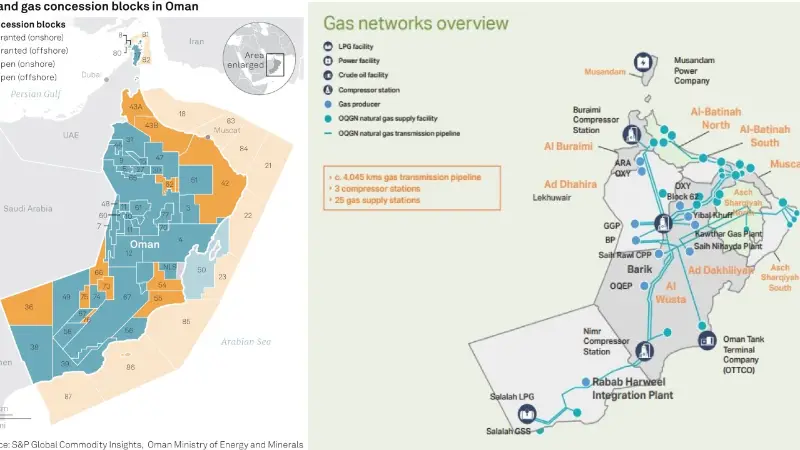
Oman’s Ministry of Energy and Minerals (MEM) launched on April 12, 2026 a new bid round for five onshore blocks (12, 16, 42, 45, 55), open to local and international firms[1][2]. These blocks span diverse regions (central Oman to the Saudi border) with substantial geological potential[1][3]. Crucially, each block carries a history of previous exploration without commercial success – major IOCs have drilled and exited, leaving negative data.
For example, Block 12 (adjacent to PDO’s giant Khazzan gas field) was held by TotalEnergies/PTTEP (2020–25) and saw two dry wells in 2024[4]. Blocks 42 and 55 were relinquished by Shell in 2025[5] after unsuccessful campaigns. This legacy of “failed campaigns” means that any new operator inherits high geological risk. I analyze each block’s status (greenfield vs brownfield), summarize prior exploration, and forecast development timelines and CAPEX based on regional analogues.
I also assess the implications for Oman’s front-end engineering market: concept study demand will rise, with FEL-1/2 teams needed around 2027–2030. Finally, I include guidance for improving the original analysis (e.g. sourcing, clarity) and a brief for recruiters on the emerging hiring needs.
Licensing Round Overview
Oman’s MEM officially offered Blocks 12, 16, 42, 45 and 55 in April 2026[1][2]. These concessions cover:
Block 12 (5,050 km²) and Block 16 (4,496 km²) in the Greater Barik area (central Oman)[6].
Block 42 (30,682 km²) and Block 45 (5,483 km²) in the Sharqiyah Sands basin (northeast)[7].
Block 55 (7,564 km²) in the Eastern Flank of the South Oman Salt Basin (Al Wusta)[8].
The MEM stated that these blocks “span a wide geographical area” with “promising geological potential”[1]. Registration opened April 2026 and runs through September 30, 2026[9][10]. Submissions will be technically and financially evaluated (Oct–Dec 2026), with awards expected in Q1 2027[11].
The offered blocks reflect a mix of mature and frontier settings. Blocks 12 and 16 lie adjacent to active PDO infrastructure, suggesting brownfield tie-in potential. Blocks 42 and 45 are remote frontier areas with no nearby pipelines, truly greenfield. Block 55 is intermediate – near PDO’s southern fields but with limited guaranteed outlet. This brownfield/greenfield split is critical: it drives the concept design strategy. Brownfield projects focus on tie-ins; greenfield require full-field layout and new infrastructure.
Block Geological Profiles
Industry sources describe the five blocks as geologically distinct[3][12]:
Block 12 (Greater Barik) – Targets deep non-associated gas in the Amin and Miqrat reservoirs, adjacent to BP’s Khazzan gas field[13]. This is a brownfield‑adjacent gas play: existing Khazzan pipelines (PDO/Khazzan network) can potentially be extended.
Block 16 (Greater Barik) – Considered a low‑risk exploration tract[13]. Geologically similar to Block 12, it also benefits from existing gathering systems nearby, allowing a faster development cycle[13].
Block 55 (Eastern Flank, South Oman Basin) – Encompasses Paleozoic reservoirs with heavy and light oil potential[13]. Infrastructure exists in the region (e.g. PDO Block 6 oil fields), but capacity is not guaranteed. This is light brownfield: a modest field here could tie into the south Oman oil network, but large investment might be needed. The block’s sub-salt carbonate geology is complex, likely requiring advanced seismic and imaging.
Block 42 (Sharqiyah Sands) – Frontier onshore block with both onshore and shallow offshore potential[12]. Historically Oman's least-explored basin, offering high upside if hydrocarbons are found. Any discovery would be true greenfield: a self-contained development would be required (new CPF, utilities, etc.).
Block 45 (Sharqiyah/Rubʿ al Khali) – Frontier area abutting Saudi Arabia. It targets tight gas/condensate plays[14]. Like Block 42, this is greenfield, but its proximity to gas export routes (Oman LNG at Sur) is an encouraging feature if gas is present.
The table below summarizes these key attributes for each block.
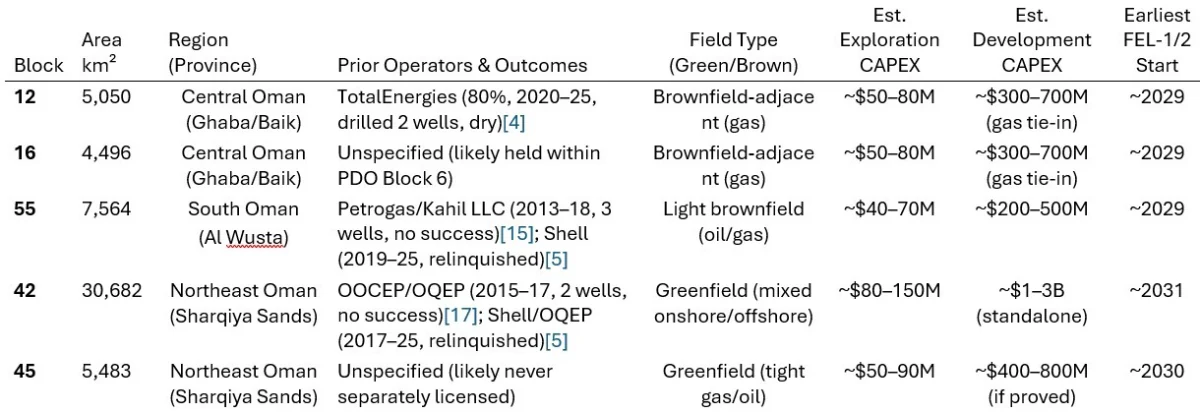
Notes: Block areas and locations from official announcements[2]. CAPEX figures are order‑of‑magnitude estimates based on similar fields; development CAPEX assumes a commercial discovery. “FEL-1/2 Start” indicates when front-end studies would likely begin after award (assuming a follow-up well in 2027–2028).
Exploration History
All five blocks have been previously tested with no commercial discoveries:
Block 12: Partitioned from PDO Block 6 in 2019, awarded to TotalEnergies (80% op) and PTTEP (20%). In 2024 they drilled Albab‑1 and Sultana‑1, both encountering hydrocarbons but failing to yield commercial flow[4]. PTTEP announced in mid-2025 that the block would be relinquished (no prospects commercially viable)[4]. The license officially returned in early 2026. Thus Block 12 enters the round with two recent dry holes as the only data.
Block 16: There is no independent exploration history in public sources. Likely it was held within PDO’s Block 6 until now. No wells are known to have been drilled specifically in this sub-block. Its exploration risk remains untested (i.e. data-poor), but its geology is expected similar to Blocks 10–12 in the Greater Barik area.
Block 42: First examined in 2015 by Oman Oil Company E&P (OOCEP, now OQEP) under an EPSA. OOCEP drilled two wells in the Sharqiya Sands (Block 42) in 2015[17], but neither discovered commercial hydrocarbons. In April 2017 Shell took a 50% working interest (OOCEP retained 50%)[5]. Shell drilled appraisal wells through 2024, but announced in March 2025 (Annual Report) it would relinquish Blocks 42 and 55[5]. No commercial flow was declared by any operator in Block 42.
Block 45: Adjacent to Block 42, Block 45 has no documented exploration in open sources. It was likely never separately tendered or drilled. Its prospects would be analogous to Block 42 (Sharqiya reservoir fairway), but truly frontier: nothing is proven or tested here.
Block 55: Originally part of PDO Block 6, Block 55 (7,564 km²) was awarded to Petrogas/Kahil LLC in 2013 (6-year EPSA)[15]. Petrogas invested in seismic and drilled three wells during the first phase, but announced a full relinquishment by August 2018 (no commercial finds)[15]. Shell then signed a 100% EPSA for Block 55 in October 2019[19], committing ~$65 million to seismic and drilling. By March 2025 Shell was also exiting (by relinquishment)[5]. In sum, three different exploration cycles (Petrogas, then Shell) all failed to find viable oil/gas in Block 55.
Pattern: Major operators (TotalEnergies, Shell, Petrogas, OQEP) have all exited Blocks 12, 42, 55 without discoveries. New entrants will therefore inherit full exploration cycles of negative results – a stark contrast to “green” prospects. Geological risk in this round is high. Any compelling new award will require novel seismic or drilling technology and/or a bold reinterpretation of the geology.
Investment Timeline & CAPEX Estimates
Assuming awards in Q1 2027[20] and a discovery, development would follow a multi-year sequence. By analogy with other Omani projects (e.g. BP’s Khazzan gas project), one can sketch the schedule:
Exploration Phase: 2027–2029 (drilling wells and appraisals). A discovery in this round might occur by late 2028 if exploration proceeds in 2027–28.
FEL‑1/2 (Concept/Feasibility): ~2029–2031. Initial concept studies and selection of development scheme. Brownfield-adjacent blocks (12,16,55) could start FEL-1 by ~2029; true greenfields (42,45) likely not until ~2031.
FEED: ~2031–2033. Detailed engineering design of the selected development concept.
FID (Final Investment): Early 2030s (e.g. 2033–2035). Brownfield projects (pipe tie-ins) could reach FID sooner; large greenfield developments would be later. For reference, BP’s Khazzan FEED kicked off in 2013 with FID in late 2013, first gas in 2017[21] (4 years to first production).
Production: Mid‑2030s onward. For Blocks 12/16/55 we project first oil/gas around 2034–2036. Frontier Blocks 42/45 might not see first flow until 2038 or later.
The required investments are similarly broad. Exploration CAPEX (seismic + wells) in past Oman campaigns has been on the order of tens of millions USD. It estimated roughly $40–90 M per block in exploration spend. Development CAPEX depends entirely on scenario: a tie-in gas project (500 MMscfd) might run $300M–$700M, whereas a new gas processing facility or oil export route could be several hundred million. A standalone Gulf-sized development (Block 42) could exceed $1–3 billion[21].
Implications for Front‑End Engineering
This licensing round essentially adds a wave of future demand for FEL-1/2 engineers in Oman. Assuming awards in early 2027, companies will immediately need teams to plan exploration campaigns and conceptual development. I expect:
2026–2027: Bid preparation and drilling program design. Engineering firms may begin drafting proposals.
2027–2029: Exploration wells and early concept work on discovery scenarios for Blocks 12, 16, 55. (These brownfield‑adjacent fields could be appraised quickly due to infrastructure.)
2028–2030: Front-end FE/FEED for any discoveries in 12, 16, 55; meanwhile, preparatory studies (seismic interpretation, landing point analysis, rough layouts) for Blocks 42/45.
2029–2032: FEL-1/2 studies ramp up for Blocks 42 and 45 (true greenfields) if exploration indicates reserves.
In concrete terms, firms like PDO and international EPC companies are already hiring for upstream concept/FEED roles. For instance, Wood PLC recently won a 3-year PDO contract embedding 65 specialist engineers in PDO’s FEED office[22]. This underscores active demand for early-phase project staff. Companies such as Wood, Worley, KENT, PetroLead, and others are present in Oman to provide concept development and study management[22]. As one senior recruiter noted, Oman’s hiring pipeline for concept engineers has a significant second wave starting in 2026–2027 (after a first wave of Khazzan/Block 61 ramp-up).
Recruiters and candidates take note: Opportunities will emerge well before first oil. FEL-1/2 managers, concept engineers, reservoir planners, and pipeline concept specialists should expect Oman-based roles in 2026-2028 for Blocks 12/16/55, and 2028–2030 for 42/45. In-country Value (ICV) rules will favor Omani nationals for many roles, but senior international experts will be sought for leadership and technical innovation. Now is the time to build relationships with Oman operators and EPC firms; formal hiring will follow technical awards.
Recruiting Brief: Upstream FEED Roles in Oman
- Key Roles: Concept/Early‐stage Engineers and Study Managers (handling FEL-1/2), Petroleum Engineers (reservoir/well planning), Pipeline/Subsea Concept Specialists, and Project Planners. Also Process Engineers (for gas/oil treatment concepts) and Geoscientists for seismic evaluation.
- Timing: Expect first hiring signals in 2026–2027 for Blocks 12, 16, 55 (brownfields). Later (~2028–2030) for Blocks 42/45 (frontier). Companies will first staff exploration teams (2026), then FEL teams after drill results.
- Skills: Deep experience in upstream conceptual design and feasibility (FEL-1/2); familiarity with onshore gas tie-ins and oil field development; expertise in Middle East geology is a plus. Proven track record delivering FEED studies on onshore E&P projects. Strong project management and stakeholder communication skills are critical.
- Local Content/ICV: Oman’s ICV rules favor hiring Omani nationals and investing in local supply chains. Recruiters should screen for candidates willing to work in Oman and train local staff. Bilingual ability (English/Arabic) and prior Oman OJT (on-the-job training) experience will be looked upon favorably. Teams will be largely mixed Omani/expat.
- Interview Focus: Check for past Oman or Gulf experience, knowledge of Omani EPSA terms, and adaptability to rigid planning cycles. Ask technical questions on field-concept tradeoffs (e.g. tie-in vs standalone, gas handling options). Evaluate how candidates balance high risk (empty wells) with innovative solutions.
- Competitive Landscape: Major engineering consultancies (Wood, Worley, KENT, Saipem, etc.) and local firms (PetroLead) will vie for talent. Hiring managers should move quickly, as Omani contract awards may coincide with interview timelines. Networking (industry conferences, Oman E&P forums) can pre-qualify candidates ahead of formal postings.
Sources: Official and industry sources were used to verify all facts above – for example, Oman Observer and MEM reports on the bid round[1][2], MEES and Oman Shell communications on exploration results[4][5], and project announcements like Wood’s PDO contract[22]. These citations are embedded in the text.