Insights / Framework · Concept Select
Integrated Field Development Is Not About Building Facilities. It Is About Managing Constraints.
Why synchronisation, not infrastructure, determines project value long before first oil.
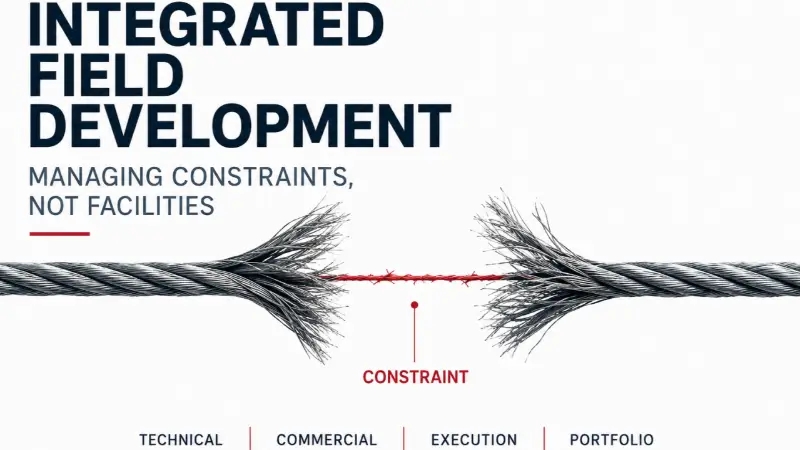
Why synchronization-not infrastructure-determines project value long before first oil.
The oil & gas industry is entering another investment supercycle.
ADNOC Group has announced up to $150 billion in capital investment through 2030 while continuing to expand its In-Country Value program and accelerate project awards. The company has recently awarded tens of billions of dollars across offshore expansion, gas, LNG and infrastructure projects while simultaneously investing in manufacturing capacity and local supply chains.
QatarEnergy is executing one of the world's largest #LNG expansion programs.
aramco continues to develop multiple upstream, gas and downstream programs in parallel.
The challenge is no longer delivering a project.
It is delivering multiple interdependent projects simultaneously while competing for engineering capacity, EPC resources, drilling rigs, long-lead equipment and capital.
In this environment, the biggest threat is rarely a technical failure. It is loss of synchronization.
A field is not a collection of facilities
It is one integrated production system.
- Reservoir engineers optimize recovery.
- Drilling teams deliver wells.
- Process engineers design production facilities.
- Pipeline engineers focus on export systems.
- Operations teams maximize availability.
- Commercial teams optimize investment returns.
Each discipline can produce an excellent solution. The asset can still underperform. Because production is never determined by the strongest subsystem. It is determined by the weakest one.
Every producing asset depends on the synchronized performance of:
- Reservoir pressure and fluid behaviour
- Well delivery
- Gathering systems
- Production facilities
- Gas processing and monetization
- Produced water handling
- Water injection
- Export infrastructure
- Utilities and power generation
Each subsystem has its own:
- Capacity
- Availability
- Operating limits
- Development schedule
- Investment profile
Optimizing one subsystem does not optimize the field.
The production system performs only at the capacity of its limiting subsystem.
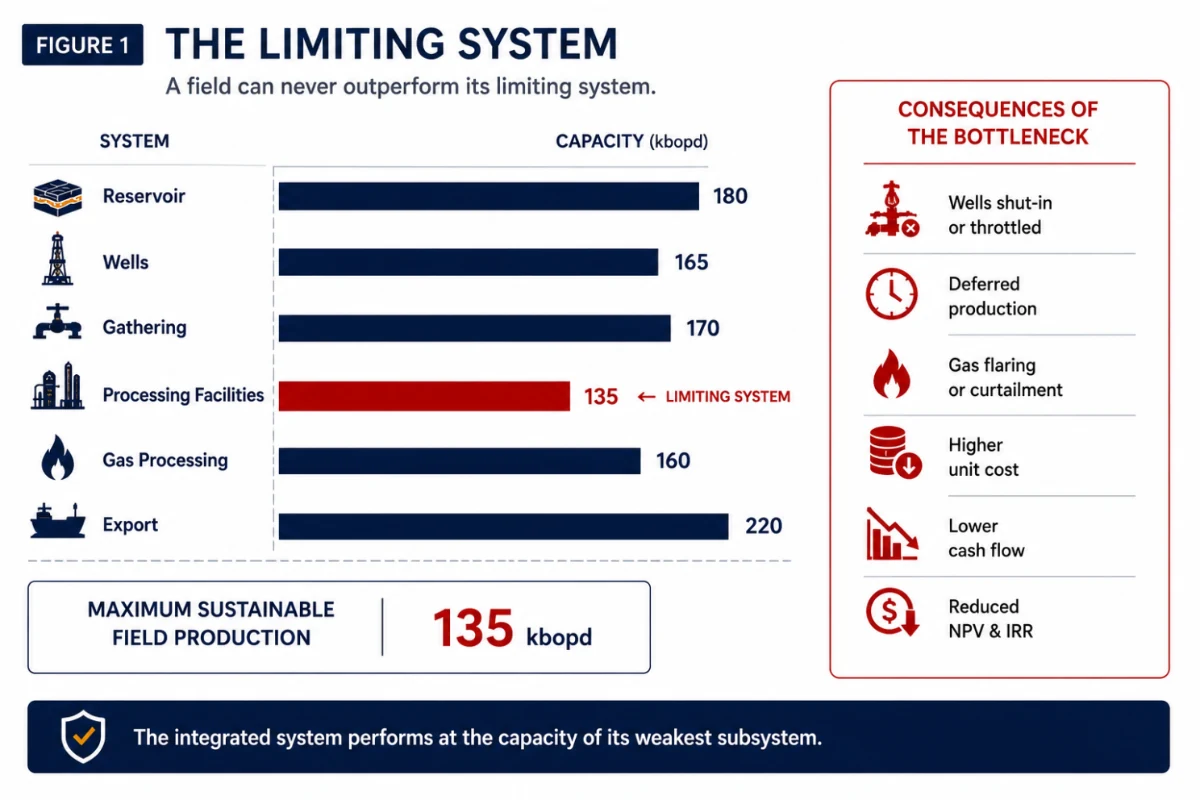
This principle is well understood in production systems engineering and is reflected in integrated production modelling and system bottleneck analysis used across the industry.
A bottleneck is never just an engineering problem.
It quickly becomes an investment problem.
When one subsystem falls behind, the consequences propagate throughout the project:
- A delayed gas compression train is not simply a mechanical issue.
- A delayed water injection system is not simply a facilities issue.
- A constrained CPF is not simply a process issue.
Each bottleneck triggers an economic chain reaction.
- Production is deferred.
- Revenue shifts to later years.
- Cash flow weakens.
- Peak funding increases.
- Unit operating costs rise.
- NPV declines.
- Portfolio priorities change.
At this point, engineering decisions become investment decisions.
This is precisely why organizations such as the Construction Industry Institute (CII) and Independent Project Analysis (IPA) consistently emphasize the importance of Front-End Planning and early project definition in improving capital project outcomes.
Constraints are supposed to evolve.
This is the idea that fundamentally changed how I think about Integrated Field Development.
Many project teams focus on eliminating constraints. In reality, constraints never disappear. They simply change. The objective is therefore not to eliminate constraints. It is to deliberately manage which constraint governs production at each stage of field life.
During early production, the reservoir should not be waiting for facilities. Gas should not be waiting for export. Wells should not be waiting for gathering systems. Surface infrastructure should not become the limiting factor while reservoir potential remains available.
As the field matures, the governing constraint should gradually migrate:
- from surface facilities;
- to gathering and export systems;
- and ultimately to reservoir deliverability.
That transition is not accidental.
It is the outcome of successful Front-End Loading.
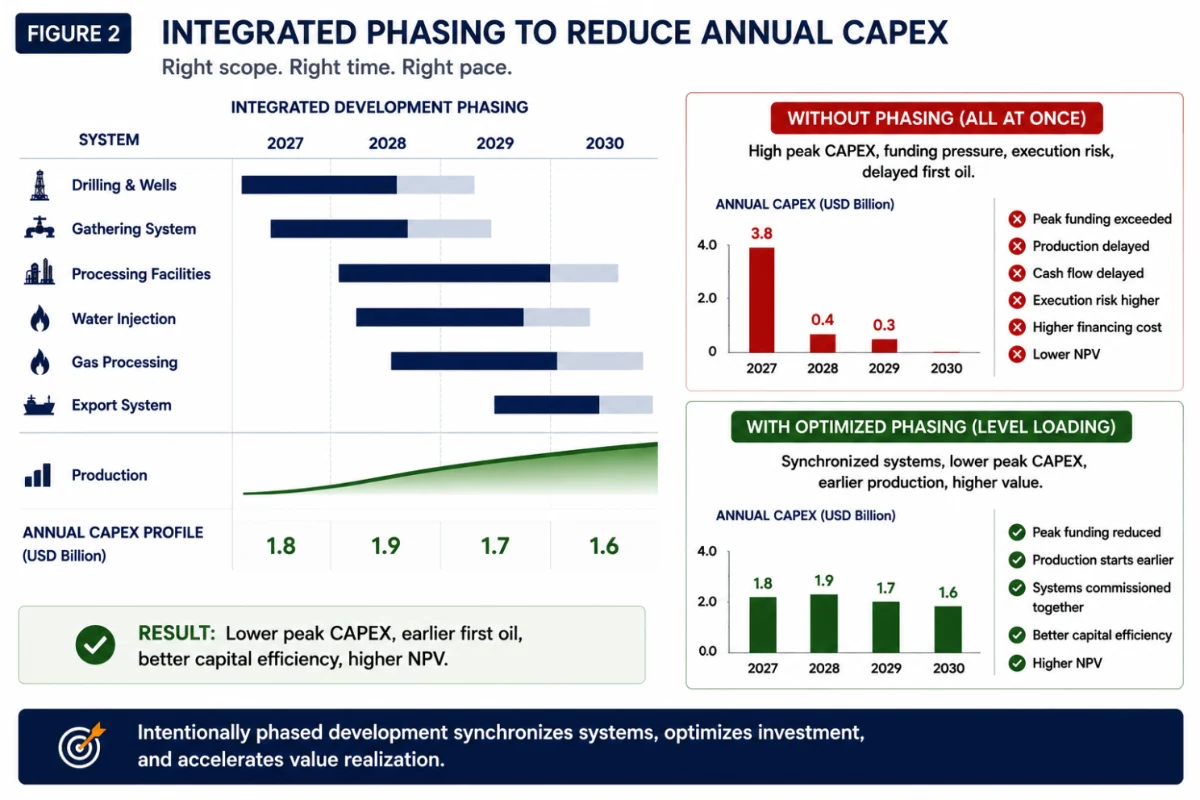
Synchronization is capital allocation.
Integrated Field Development is often described as coordinating engineering disciplines.
That definition is incomplete.
The real objective is to synchronize:
- technical readiness;
- investment timing;
- construction sequencing;
- drilling campaigns;
- commissioning;
- production ramp-up.
Good phasing creates value because it simultaneously:
- smooths annual CAPEX;
- reduces peak funding requirements;
- accelerates first production;
- improves cash flow timing;
- increases equipment utilization;
- reduces interface risk;
- preserves future development flexibility.
This is why the best development plans are rarely those that maximize construction speed.
They maximize synchronization.
Key takeaway
This is why FEL exists.
Front-End Loading is frequently described as concept selection.
That is only part of its purpose.
Its real value lies in aligning four groups of constraints before detailed engineering begins.
Technical
- reservoir behaviour;
- production profiles;
- processing capacity;
- gas monetization;
- water management.
Commercial
- annual CAPEX;
- NPV;
- IRR;
- cash flow;
- peak funding.
Execution
- drilling capacity;
- EPC availability;
- long-lead equipment;
- logistics;
- commissioning sequence.
Portfolio
- project interfaces;
- shared infrastructure;
- corporate investment priorities;
- resource competition;
- program delivery.
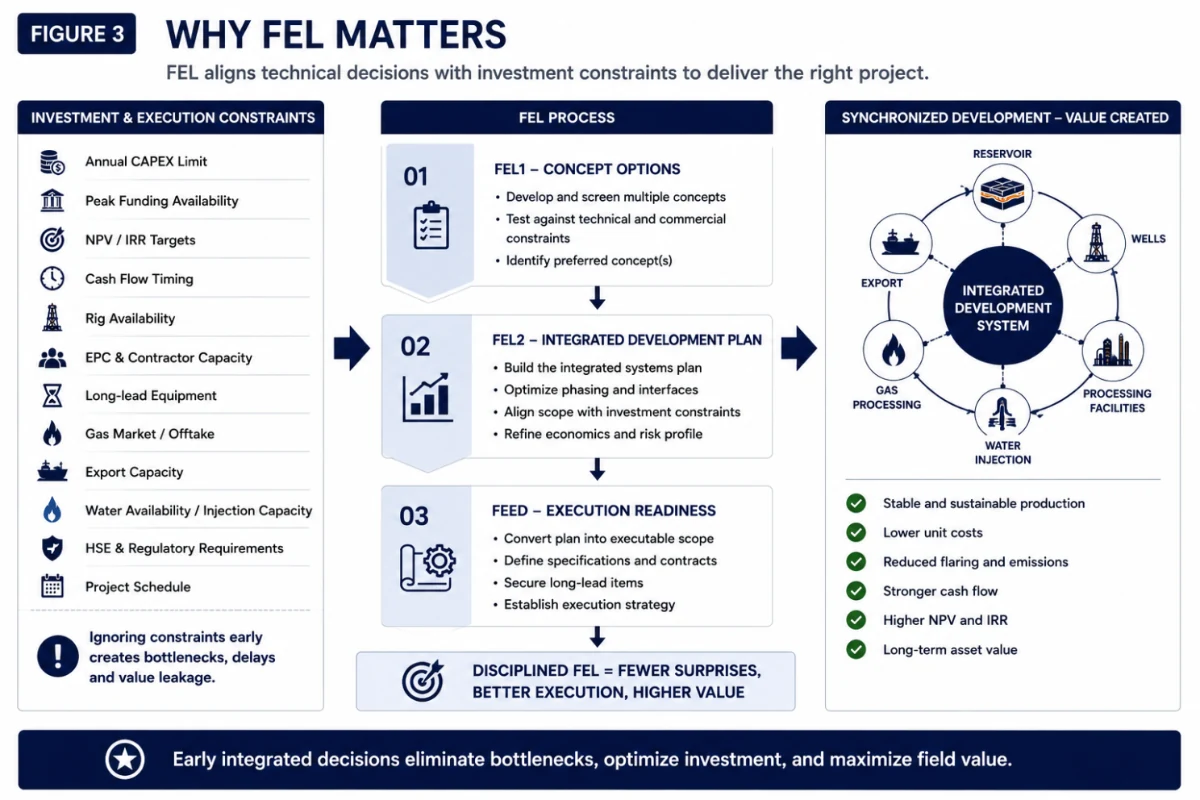
By the time a project reaches FEED, the ability to influence these decisions has already reduced dramatically.
This is why the greatest value is created during FEL1 and FEL2-not because more engineering is performed, but because the most consequential decisions are still reversible.
Material balance extends beyond the reservoir.
Material balance is often viewed as a reservoir engineering tool.
In reality, it describes the behaviour of the entire production system.
Every barrel produced must be:
- gathered;
- processed;
- transported;
- exported.
Associated gas must be:
- commercialized;
- reinjected;
- utilized for power generation;
- or otherwise managed without unnecessary flaring.
Produced water must be treated and reinjected to maintain reservoir pressure and maximize ultimate recovery.
A mismatch anywhere in this chain creates a new constraint. The production system does not recognize organizational boundaries. It responds only to physical balance.
Final thoughts
After participating in more than 50 early-phase studies, one observation has become increasingly clear to me. The most successful developments are rarely those with the largest facilities or the most aggressive production targets. They are the projects where engineering, economics and execution remain synchronized from concept selection through startup.
Every field will always have a governing constraint. The question is not whether it exists.
The question is whether you chose it deliberately-or discovered it too late.
In my view, that is the real purpose of Integrated Field Development. And that is where Front-End Loading creates its greatest value.
References
- Construction Industry Institute – Front-End Planning (industry research demonstrating the relationship between robust front-end planning and improved cost/schedule performance).
- Independent Project Analysis – Project Definition Rating Index (PDRI) methodology for project readiness assessment.
- Society of Petroleum Engineers – Front-End-Loading (FEL) Process Supporting Optimum Field Development Decision Making (SPE 167655).
- TU Delft – research on Front-End Loading and integrated field development.
- Recent public investment announcements by Abu Dhabi National Oil Company, QatarEnergy and Saudi Aramco illustrate the increasing importance of synchronized program delivery across large capital portfolios.