Insights / Iraq
What Iraq's 2026 deals are really about
Five companies, five different strategies, one common logic behind the wave of upstream agreements signed in Iraq this year.
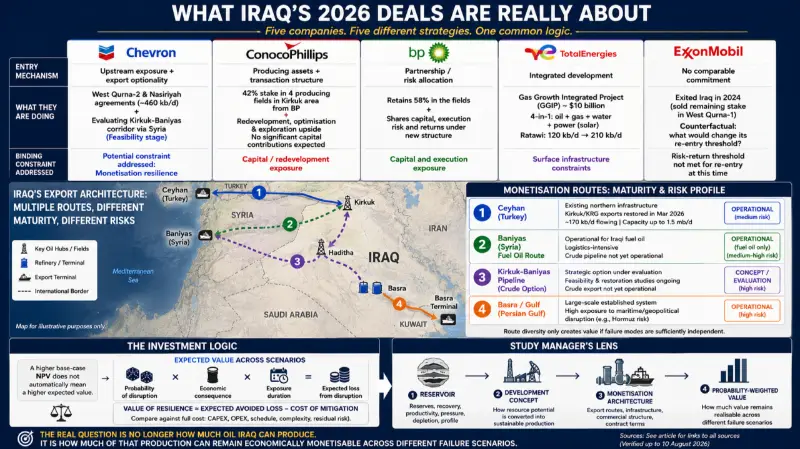
Five companies. Five different strategies. One common logic.
In ten days in July 2026, Chevron signed agreements covering West Qurna-2 and Nasiriyah, ConocoPhillips announced a 42% stake acquisition in four Kirkuk-area fields, TotalEnergies continued advancing its $10 billion Gas Growth Integrated Project, and ExxonMobil - which had fully exited Iraq in early 2024 - remained absent from the table.
The standard read is "majors returning to Iraq."
That framing misses the more useful question.
They are not solving the same problem. That is exactly why the comparison matters.
The reservoir still comes first
Before getting to the deals, one principle needs to be clear.
Discussions about Iraq that treat export infrastructure or geopolitical positioning as primary value drivers will lead to wrong conclusions. The starting point remains the resource: reserves, recovery factor, well productivity, production profile, reservoir pressure and depletion, development scale, CAPEX and OPEX. These determine the underlying economic potential. The development concept determines how efficiently that potential converts into production. Only after that do external factors determine how reliably the resulting value can be realised.
In the earlier articles in this series, I framed this as:
Realisable Project Value = Economic Potential × Delivery Certainty
But Delivery Certainty is not a single coefficient applied to the base case. In practice, it means assessing probability-weighted value across credible scenarios - where each scenario carries a different likelihood and a different economic consequence. A project with a high base-case NPV and a material probability of losing access to its export route has a lower expected value than that NPV implies.
Kurdistan showed why in March 2023. In March 2023, roughly 450,000 b/d of northern Iraqi crude exports were interrupted and Kirkuk production stopped - not because the reservoirs failed, but because the monetisation pathway did. The subsurface was intact. The wells were capable of producing. The value could not be realised.
The 2026 Iraq deals can be read through that lens. Each structure attempts to address a different component of the same underlying problem: how to convert a high-quality resource into realisable long-term value under material uncertainty.
What has changed since 2023
Before analysing the five companies, the export picture itself needs to be stated accurately - because it has changed substantially, and it changes the analysis.
In March 2026, Kirkuk and Kurdistan exports resumed through the Ceyhan route at an initial 250 kb/d. On 1 August 2026, Iraq and Turkey signed a one-year extension of the Iraq-Turkey Pipeline agreement, with current flows around 170 kb/d against a technical capacity of up to 1.5 mb/d.
In parallel, a different route has emerged - but at a different level of maturity. Iraqi fuel oil is now moving through Syria to Mediterranean markets, including the United States. This is an operational logistics route for fuel oil. A crude oil pipeline through Syria to Baniyas is a different proposition - it is currently the subject of feasibility studies, not an operational crude export system.
Iraq is therefore not replacing one export route with another. It is building optionality across several routes with very different maturity, capacity and risk profiles:
- Ceyhan - operational northern route, institutionally dependent on the Iraq-Turkey bilateral arrangement, currently running well below technical capacity
- Baniyas fuel-oil route - operational for refined products, logistics-intensive, not equivalent to crude pipeline export
- Kirkuk-Baniyas crude pipeline - a strategic concept under feasibility study, not yet an operational crude route
- Basra/Gulf - the dominant southern export system, large-scale and established, but exposed to maritime disruption
Four routes are not four independent options. The analytical question is not how many routes exist. It is which failure modes each route protects against - and whether those failure modes are sufficiently independent of each other.
Chevron: participating in the option-creation process
The agreement covering West Qurna-2 and Nasiriyah brings Chevron into a field producing around 460,000 b/d, previously operated by LUKOIL.
The production exposure is significant. But Chevron is not simply adding barrels to its portfolio.
In early July, a consortium including Chevron and UCC received a mandate to conduct technical and financial feasibility studies on strategic export pipeline routes - including both Basra-Haditha-Ceyhan and Basra-Haditha-Baniyas corridors. The US government subsequently expressed support for the revival of the Kirkuk-Baniyas route.
Chevron is not yet buying an alternative export route. It is participating in the process of creating export optionality around Iraqi crude - which means it could potentially influence not only how much oil is produced, but how reliably that oil reaches market under different scenarios.
That is a different investment proposition from upstream-only exposure. The value of that position depends on whether the feasibility studies lead to an executable development, and -critically - whether the failure modes of any new route are sufficiently independent from those affecting the existing export system.
A Study Manager should never model a route under feasibility study as if it were already operational. But the question on Chevron is positioning around - is there a monetisation pathway with a meaningfully different risk profile - is exactly the right concept-stage question.
ConocoPhillips: restructure the entry before committing
The Kirkuk transaction is the most structurally precise deal of the group.
The four fields are already producing, with more than 3 billion boe of gross recoverable resources. ConocoPhillips is not taking frontier exploration risk. It is taking redevelopment and incremental-production risk on already-producing assets - a meaningfully different exposure profile. Reservoir uncertainty, well performance, pressure support, water cut and brownfield rehabilitation remain real considerations. But they are not the same as greenfield subsurface risk.
The commercial structure is as important as the technical one. ConocoPhillips explicitly noted the transaction is not expected to require significant capital contributions from ConocoPhillips, with remuneration linked to its proportional share of incremental production and costs. The structure materially reduces upfront capital exposure.
The lesson is not that ConocoPhillips "returned to Iraq." It is that transaction structure can change the risk-return profile of the same resource without changing the geology. Two development propositions built around the same reservoir can look very different depending on ownership structure, remuneration mechanism, cost recovery terms and risk allocation. This is a concept selection principle applied at M&A scale.
BP: the other side of the same table
bp is instructive from the sell side of the same transaction.
The question is not only what ConocoPhillips receives. It is how the partnership structure changes the capital and execution exposure of the existing participants.
The same reservoir. Different risk allocation. Therefore different expected value for each party - without the subsurface changing at all.
Before committing to any development structure, the question of who carries which risk, under what commercial terms, for what proportional return, is as important as the production profile itself.
TotalEnergies: the full value chain as the unit of analysis
The Gas Growth Integrated Project combines oil redevelopment, associated gas recovery, gas processing, seawater treatment and solar power in a single integrated development. Phase 1 targets 120,000 b/d at Ratawi, Phase 2 targets 210,000 b/d, with approximately $10 billion in total investment.
The reservoir opportunity at #Ratawi is real. But that opportunity could not be fully monetised without solving multiple surface constraints simultaneously: water availability for injection, associated gas handling, power supply, processing capacity. TotalEnergies is not replacing reservoir engineering with infrastructure engineering. It is linking them into one development proposition.
The study boundary should follow the value chain until the binding constraint is inside the model.
If the reservoir can produce an additional 100 kb/d but the water injection system cannot support it, the water system is part of the field development value problem. If additional oil creates associated gas that cannot be handled economically, gas handling becomes part of the oil development problem.
Optimising the oil field in isolation - while the actual constraints sit in water, gas or power - leaves the incremental value unrealised. That is what the integrated project structure is designed to address.
ExxonMobil: the counterfactual that matters most
ExxonMobil is the most analytically useful case - but not for the reason most commentaries suggest.
ExxonMobil fully exited Iraq in early 2024, selling its remaining stake in West Qurna-1. It is therefore not a company that "declined to participate" in the 2026 wave. It is a company that had already assessed Iraq's risk-return profile and made a definitive exit decision.
That makes the counterfactual more interesting, not less.
The question is not why ExxonMobil did not join the 2026 deals. The question is: what would have to change in Iraq's investment environment for a company that made a deliberate exit decision to reconsider?
That question - stated explicitly - tells you more about the conditions required for durable large-scale capital commitment than any analysis of who did enter. Resource attractiveness alone clearly did not hold ExxonMobil in the country. Contractual structure, capital terms, export pathway reliability, institutional stability and probability-adjusted return all factor into that threshold.
The absence of re-entry is informative. Sometimes the most important signal is not who entered. It is what the entry conditions would need to look like.
What these strategies share
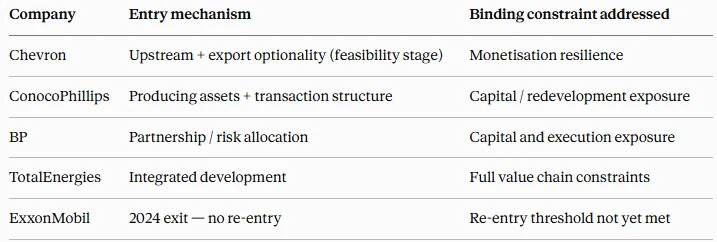
The common logic is not "Iraq is attractive."
Each structure appears to be addressing a different component of Delivery Certainty — export resilience, capital exposure, subsurface risk, infrastructure constraints, commercial terms. Each company assessed a different variable as the binding constraint on its investment thesis and built a different structure around it.
The correlated risk problem
There is one more dimension that most analyses are missing.
Iraq is now building a portfolio of export options - Ceyhan, Baniyas fuel-oil, the proposed Kirkuk-Baniyas crude pipeline, Basra/Gulf. But the number of routes is not what determines export resilience.
Route diversity is only valuable to the extent that the failure modes are sufficiently independent.
If the same regional event can disrupt multiple routes simultaneously, the apparent redundancy provides far less protection than it suggests. The right question is not "how many export routes does Iraq have?" It is: what failure mode does each alternative protect against, and is that failure mode independent of the others?
A useful framing for concept comparison:
Expected value of resilience ≈ Probability of disruption × Economic consequence × Exposure duration
Compare that expected avoided loss against the full cost of the mitigation: CAPEX, OPEX, schedule, operating complexity, residual risk. The answer is not automatically "build the alternative route." Sometimes the cost will not be justified. Sometimes it clearly will. Either way, the analysis belongs in the concept study - not in a separate risk register without a formal owner.
The investment logic, stated directly
A higher base-case NPV does not automatically mean a higher expected value.
Consider two development concepts. Concept A generates $1.0 billion NPV in the base case but carries a material probability of losing access to its export route for an extended period. Concept B generates $850 million in the base case but materially reduces that exposure. The correct comparison is not $1.0 billion versus $850 million. It is the probability-weighted value across the relevant scenarios for each concept.
The real development question is no longer simply how much oil Iraq can produce. It is how much of that production can remain economically monetisable across different failure scenarios.
A reservoir with strong productivity, reserves and recovery potential creates the economic opportunity. The development concept determines how efficiently that opportunity converts into production. Export architecture, commercial structure and institutional stability determine how much of that value remains realisable when the base case breaks.
Reservoir → Development Concept → Monetisation Architecture → Probability-weighted Value
The five Iraq strategies described here are each a version of this calculation - applied to different constraints, by different organisations, using different commercial and technical mechanisms.
The most defensible concept is not always the one with the highest base-case NPV. It may be the one that preserves the most value when the assumptions behind that NPV stop being true.
The job is not to eliminate uncertainty. It is to understand which uncertainty can change the investment decision - quantify its consequence - and decide whether buying it down creates value.
18+ years in upstream oil & gas on the operator side. 50+ FEL and Pre-FEED studies. If you are working on concept selection or early-phase project development in the Middle East, I am available for engagements.
Sources
- Chevron — West Qurna-2 and Nasiriyah, Reuters, 16 July 2026
- Iraq — export pipeline feasibility mandate, Reuters, 5 July 2026
- Iraqi fuel oil via Syria, Reuters, 23 July 2026
- Iraq-Turkey pipeline extension, Reuters, 1 August 2026
- KRG — March 2026 export resumption
- ConocoPhillips — Kirkuk transaction
- TotalEnergies — Gas Growth Integrated Project
- ExxonMobil — 2023 Annual Report / Iraq exit
- Kurdistan export halt, March 2023, The National
- Gulf exports, August 2026, Reuters