Insights / Framework · Portfolio
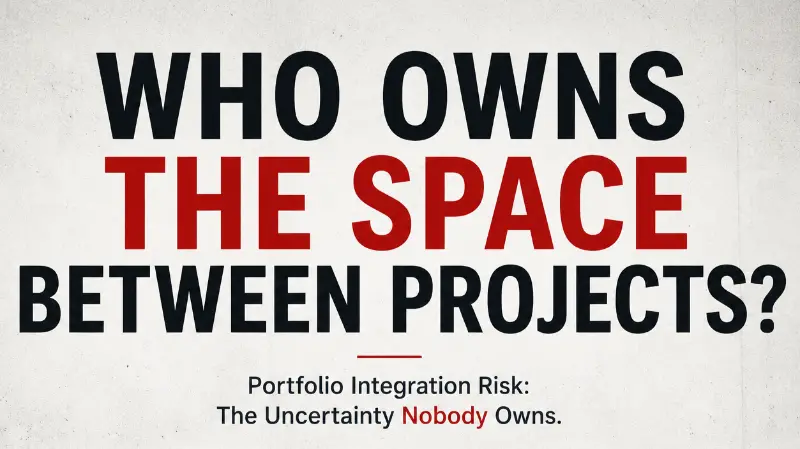
Portfolio integration risk: The uncertainty nobody owns
The risk that sits between projects: shared infrastructure, execution capacity and capital that no single project team is accountable for.
This is the second article in a series on delivery certainty and its implications for #FEL, project governance and portfolio management.
The first article proposed a framework for thinking about why major upstream investment decisions have converged on a common engineering principle: systematically reducing delivery uncertainty across its different domains before committing capital.
It ended with a question Iraq will eventually need to answer.
Improving export certainty and institutional certainty attracts more operators. More operators simultaneously executing major capital programmes introduces a category of risk that no individual operator's model formally captures - and that nobody currently owns.
This article is about that risk.
What individual project models miss
When an operator develops an investment case at FEL1 or FEL2, the delivery certainty assessment is necessarily project-centric. It evaluates whether this project can be engineered, procured, constructed, commissioned and operated to deliver its modelled economics.
What it does not evaluate - because it cannot, within the boundary of a single project - is what happens when multiple capital programmes with overlapping resource requirements are executed simultaneously.
The number of potential interfaces between concurrent programmes grows non-linearly as the portfolio expands:
Potential interfaces = n(n−1)/2
Two programmes share one interface. Three share three. Five share ten. Ten share forty-five.
Interface complexity therefore grows non-linearly with the number of concurrent programmes. Each interface is a potential source of delivery certainty degradation that appears in nobody's project model.
What these interfaces actually look like
The shared constraints that create portfolio integration risk are not abstract. They are specific and physical.
EPC and fabrication capacity. Major offshore fabrication yards, specialist heavy-lift vessels and deepwater installation contractors operate at finite capacity. When two or more programmes requiring the same contractor category reach EPC simultaneously, one or both face schedule degradation - not because either project was poorly designed, but because combined demand exceeds available supply. This is precisely the constraint ADNOC is attempting to address proactively through local manufacturing development and early contractor engagement - because the portfolio-level demand signal was visible before individual project awards.
Export infrastructure. A single export corridor serving multiple concurrent developments creates a sequencing dependency that no individual operator controls. Kurdistan demonstrated what happens when that corridor fails. The less-discussed risk is what happens when it becomes congested - when multiple expansion programmes require simultaneous access to the same export node during their peak construction and commissioning phases.
Utilities and site infrastructure. Power, water injection, gas processing and logistics systems shared across adjacent developments create interdependencies that affect delivery certainty for all programmes using them. A delay in shared utility commissioning affects every project depending on it, regardless of how well each individual project was engineered.
Regulatory and permitting processes. When multiple major projects simultaneously require environmental assessments, permitting decisions and regulatory approvals from the same authorities, processing capacity becomes a shared constraint. This rarely appears in individual project schedules.
Specialist human capital. Commissioning engineers, discipline leads, interface managers and regulatory specialists exist in finite numbers. A portfolio that absorbs the majority of available regional capacity creates a human resource constraint that manifests as schedule compression across all concurrent programmes simultaneously.
Why this risk is structurally invisible
Portfolio integration risk has a specific property that makes it particularly difficult to manage: it is individually rational but collectively problematic.
Portfolio Integration Paradox: Decisions that maximise delivery certainty for individual projects can reduce delivery certainty across the portfolio.
Each operator, making a fully rational investment decision based on its own project's delivery certainty assessment, contributes to a portfolio-level condition that degrades delivery certainty for all operators simultaneously. No individual operator has made an error. The risk emerges from the interaction of individually sound decisions.
This is structurally different from project risk, which can be identified, assigned an owner and managed within the project boundary. Portfolio integration risk has no natural owner at the project level. It exists between projects, not inside them.
In classical FEL governance, the gate review asks: is this project ready to proceed to the next phase? It does not ask: is the portfolio of projects this programme sits within ready to be executed simultaneously? These are different questions, and only the first one currently has a formal answer.
Where the responsibility sits
The gap this creates is not primarily an engineering problem. It is a governance problem.
Individual operators cannot be expected to model portfolio-level constraints that depend on other operators' decisions. Host governments and national oil companies are often the only entities with visibility across the full portfolio - but they may lack the portfolio integration capability to identify and manage the interfaces between concurrent programmes.
The result is that portfolio integration risk accumulates in the space between organisations, between project boundaries and between governance frameworks - precisely where formal accountability is weakest.
In Iraq's specific situation, the entities with portfolio-level visibility include the Ministry of Oil, the Basra Oil Company and the North Oil Company. Whether they currently have the systems engineering capability to identify portfolio-level delivery certainty risks - across programmes operated by Chevron , ConocoPhillips , bp , TotalEnergies , ExxonMobil , #CNPC, Eni and LUKOIL simultaneously - is a question that the investment cases of individual operators cannot answer.
What managing this risk requires
Portfolio integration risk cannot be eliminated, but it can be managed - if it is identified early enough.
The prerequisite is treating portfolio-level delivery certainty as an explicit analysis objective at concept stage, not as an assumption that individual project teams resolve through their own schedule management.
Practically, this means identifying the shared resource nodes - fabrication, export, utilities, regulatory - across concurrent programmes before individual project concepts are frozen. Understanding which delivery certainty domains are shared across the portfolio, and therefore subject to degradation if demand concentrates simultaneously. Designing individual project sequencing and concept selection with portfolio-level resource constraints as explicit inputs, not as FEED-stage discoveries. And establishing governance mechanisms - whether through a national programme office, an operator coordination body, or bilateral scheduling agreements - that give portfolio-level delivery certainty a formal owner.
None of this is standard practice today. In most FEL frameworks I have been part of, portfolio-level resource constraints enter the conversation at EPC award, when individual concepts are locked and sequencing options are limited.
The next engineering challenge
The first article proposed that Iraq's competitive advantage is gradually shifting from the quality of its reservoirs toward the quality of its delivery environment.
Portfolio integration risk is where that shift becomes most consequential.
A country can improve export certainty. It can improve institutional certainty. It can attract a diversified portfolio of major international operators. And then discover that the delivery environment it worked to create is being degraded by the portfolio-level interactions of the very investments it attracted.
The engineering challenge is not attracting concurrent programmes. It is ensuring they can be delivered concurrently without competing for the shared resources and infrastructure that underpin delivery certainty for all of them.
That is likely to require a portfolio-level systems engineering capability - not just well-engineered individual projects.
18+ years in upstream oil & gas on the operator side, 50+ FEL and Pre-FEED studies. [email protected]
Sources