Insights / Kurdistan
The industry spent a decade reducing engineering uncertainty. Kurdistan added two more variables.
Project value depends on more than reserves. In Kurdistan, two variables outside engineering can make or break the investment case.
Over the past decade, a remarkable number of major upstream investment decisions - across different operators, regions and project types - have converged on a common engineering principle, even when they appear to solve very different problems.
- Brownfield tie-backs
- Phased developments
- Standardized facility designs
- Portfolio high-grading
- Digital twins
All reduce different categories of uncertainty that threaten successful project delivery.
At first glance these appear to be independent optimisation decisions driven by cost, schedule or capital efficiency. Viewed together, however, they reveal a consistent engineering pattern. Each decision removes a different source of uncertainty before Final Investment Decision rather than simply improving the project's nominal economics.
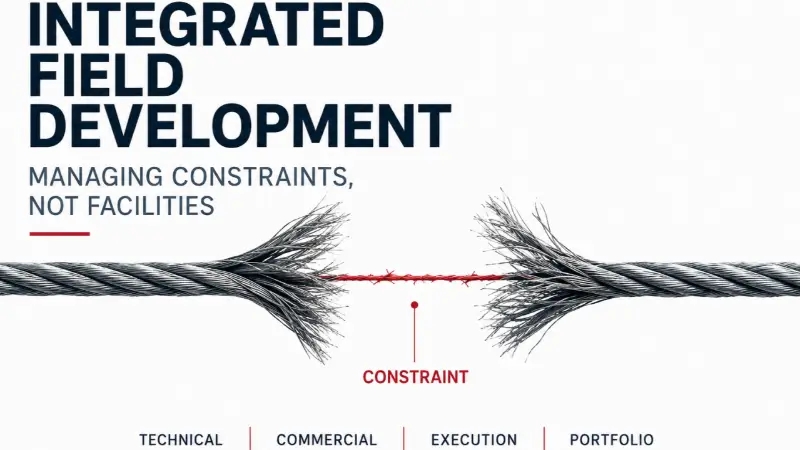
Yet almost all of that uncertainty sits inside the project boundary.
BP replicating 85% of the Kaskida platform design in Tiber compresses engineering and procurement uncertainty through repeated specifications and identical wellhead systems. Equinor tying Isflak back to Johan Castberg at 8.5 kilometres eliminates the need for a new host facility and delivers payback in under 2.5 years - reducing both engineering and financial execution uncertainty. ENI phasing Baleine rather than sanctioning full field development commits Phase 3 capital only after Phase 1 and 2 cash flows have validated reservoir assumptions - reducing investment uncertainty. Shell 's digital twin on Bonga, extended to support the upcoming Bonga North tie-back, reduces operational uncertainty through predictive maintenance and real-time integrity monitoring. ConocoPhillips screening its resource base at a cost of supply below $40 per barrel WTI reduces economic uncertainty across commodity cycles. ExxonMobil's Yellowtail development in Guyana, which came in four months ahead of schedule and under budget, demonstrates what happens when delivery conditions are sufficiently robust across all dimensions simultaneously.
The surface-level story is capital discipline. The deeper pattern is the systematic elimination of uncertainty across every dimension of project delivery - but specifically, uncertainty that originates inside the project itself.
Kurdistan changed that.
A framework for thinking about project value realisation
Modern upstream investment decisions already combine economics with uncertainty. Reserve certification incorporates geological uncertainty.
- Monte Carlo analysis captures cost and schedule variability.
- Decision trees evaluate alternative development pathways. P10, P50 and P90 scenarios explicitly acknowledge that future outcomes are probabilistic rather than deterministic.
The framework proposed here does not replace these established methods. Instead, it suggests that a broader category of uncertainty has become increasingly important in determining whether the economic value predicted by these models is ultimately realised.
One way of expressing this investment logic is:
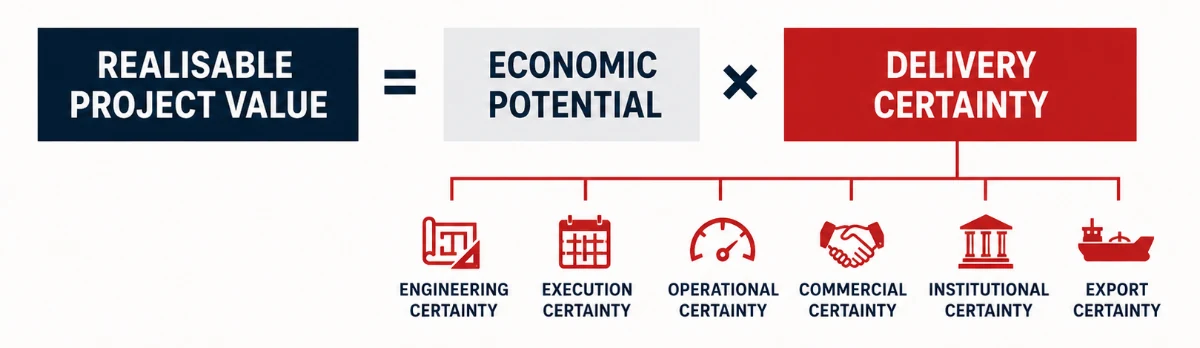
Delivery Certainty is not a single variable. It represents the combined effect of multiple uncertainty domains:
- Engineering Certainty
- Execution Certainty (schedule, cost, contractor delivery)
- Operational Certainty
- Commercial Certainty
- Institutional Certainty
- Export Certainty
This article does not attempt to quantify Delivery Certainty. It is introduced here as a conceptual construct whose individual domains may be assessed using different methods depending on project context.
The relative importance of each domain varies by project, geography and development concept, but together they influence the likelihood that projected economic value will ultimately be realised.
Historically, most investment frameworks have focused on uncertainty that originates within the project itself - reservoir behaviour, engineering execution, construction performance and cost estimation. The examples above demonstrate how operators have systematically reduced these internal uncertainties through standardisation, phased development, tie-backs and portfolio high-grading.
The Kurdistan export disruption did not invalidate existing project evaluation methods. Instead, it exposed two uncertainty domains that proved capable of dominating otherwise sound project economics.
What Kurdistan actually demonstrated
Projects with technically robust reservoirs, unchanged production forecasts and unchanged development costs nevertheless lost the ability to generate cash flow - because export continuity and institutional arrangements failed.
The event therefore highlighted two dimensions of uncertainty that appear to deserve greater weight in long-cycle investment decisions.
- Export Certainty - can barrels physically and continuously reach a market throughout the project's life cycle, regardless of geopolitical or infrastructure disruption? Following an ICC arbitration ruling in favour of Baghdad, exports through the Kirkuk–Ceyhan pipeline halted in March 2023, removing approximately 450,000 barrels per day of Kurdish crude from markets for nearly 30 months. The reservoir performed. The operator performed. The export system did not.
- Institutional Certainty - will the rules of engagement between operator, host government, and relevant authorities remain stable enough for the project to generate its modelled cash flow over a 20-year horizon? The September 2025 Iraq–KRG restart agreement began to address this, but the episode demonstrated that institutional arrangements can fail independently of technical and commercial project performance.
In decision analysis terms: the reserves did not change. The production profile did not change. The CAPEX estimate did not change. The NPV model did not change. What changed was the estimate of how likely it was that the modelled value would actually be realised.
Why the 2026 Iraq announcements look different through this lens
None of the following observations proves that international operators have formally adopted a new investment methodology or use the terminology proposed here. Rather, the consistency of recent project design decisions across multiple companies suggests that reducing delivery uncertainty has become an increasingly important objective alongside improving project economics. The framework presented here should be viewed as an analytical interpretation that seeks to explain a broad set of observable investment decisions, rather than as a description of an officially adopted industry methodology.
ConocoPhillips acquiring a 42% stake in BP's Kirkuk joint venture with remuneration tied directly to incremental production - minimal upfront capital exposure before the production profile validates - is structurally identical to a phased development approach. Commit less capital before the delivery certainty side of the equation resolves. Take value out as it materialises. This is the same logic as Eni Baleine phases, applied to institutional and export uncertainty rather than reservoir uncertainty.
Chevron's reported interest in evaluating both field opportunities and alternative export routes is consistent with a decision framework in which export certainty is treated as an explicit investment variable rather than an operational assumption. While alternative explanations certainly exist - including geopolitical, commercial and logistical considerations - the observed behaviour aligns with the broader pattern of reducing delivery uncertainty before committing capital.
ExxonMobil 's renewed interest in Iraq is similarly consistent with a reassessment of delivery conditions. Whether driven by improvements in institutional arrangements, export certainty, commercial terms or a combination of these factors, renewed engagement suggests that factors extending beyond reservoir quality are influencing investment attractiveness. ExxonMobil's execution in Guyana demonstrates how aggressively the company invests when delivery conditions are sufficiently robust. The relevant question is whether Iraq is gradually improving those conditions.
TotalEnergies' continued commitment to the $27 billion Gas Growth Integrated Project - simultaneously addressing gas monetisation, power generation and water treatment - reflects investment in the infrastructure layers that improve Iraq's operational and export certainty across the portfolio, not just in the hydrocarbons themselves.
The September 2025 export restart agreement signals to every operator in the room that Baghdad treats export continuity as a strategic priority and is willing to reach agreements to maintain it. That directly affects the delivery certainty variable in every operator's internal investment model.
What this suggests about what Iraq is actually offering
Drilling technology is not scarce and it is not Iraq's constraint. What major international operators bring that is harder to replicate is the ability to manage large, complex capital programmes under the disciplines that their shareholders and boards now require: capital efficiency, phased commitment, standardized execution, ESG compliance for reserve-based lending covenants, predictable cash flow generation.
But the more important observation may be about what Iraq appears to be offering in return.
Improved export architecture through the Kirkuk–Ceyhan restart and alternative routing discussions. A federal - #KRG agreement that reduces the single largest source of export uncertainty that crystallised in 2023. A diversified operator base that reduces country risk concentration for any individual partner. Infrastructure investment across gas, power and water that reduces operational dependencies.
These are not field improvements. They are delivery certainty improvements - specifically, improvements to the two uncertainty domains that Kurdistan revealed as decisive.
If this interpretation is correct, Iraq's competitive advantage is gradually shifting from the quality of its reservoirs toward the quality of its delivery environment.
Reservoirs determine what a project could become. Delivery certainty determines how much of that potential is ultimately realised.
That may be Iraq's next engineering challenge - and it is the subject of the next article in this series.
The industry has spent a decade reducing uncertainty inside projects. The next decade may be defined by how well it manages uncertainty between projects.
This article is analytical interpretation based on publicly available information. Neither the Iraqi Ministry of Oil nor the operators involved have formally described this as a coordinated strategic shift. The framework presented here - Realisable Project Value = Economic Potential × Delivery Certainty - is proposed as an explanatory model, not an established industry standard.
18+ years in upstream oil & gas on the operator side, 50+ FEL and Pre-FEED studies. [email protected]
Sources
- ConocoPhillips acquires 42% in BP's Kirkuk joint venture — Reuters
- Chevron close to preliminary deal on Iraqi oilfields — Reuters
- Iraq–Turkey agree to restart Kurdish oil exports — Reuters, September 2025
- Kurdish oil exports resume — Kurdistan24, September 2025
- TotalEnergies Basrah Gas Growth Integrated Project
- ENI Baleine Phase 3 FPSO EPCIC award — Offshore Magazine
- Equinor Capital Markets Day 2026
- ConocoPhillips Q1 2026 Earnings Transcript
- ExxonMobil 2025 Full Year Results