Insights / Kazakhstan
Kazakhstan just put 24 blocks on the table. The number that matters isn't 24.
An auction of options, not acreage: a cheap entry ticket, an expensive strike price, and constraints that move from geology to wells, surface and export.
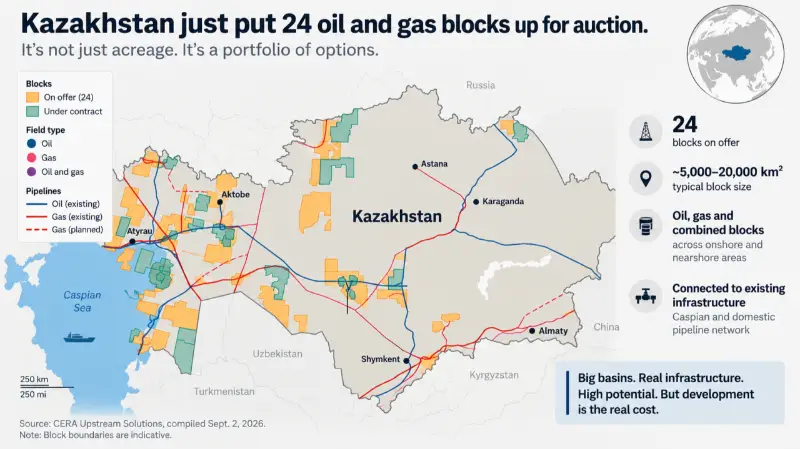
On 5 August 2026, Kazakhstan's Ministry of Energy announced an electronic auction for 24 hydrocarbon blocks, exploration and production rights across several basins.
The headline reads like acreage. Two frontier tracts in Mangystau alone run to several thousand km2 each.
But acreage is not the number that decides anything. I want to make the case that this auction is not a sale of oil. It is a sale of options - and the two are priced, risked and executed completely differently.
What is actually being sold
Owning a large block in Ustyurt does not give you a barrel of oil. It gives you the right to spend money finding out whether oil is there.
The Ministry's own terms make this explicit. A winning bidder must prepare an exploration project within one year, complete minimum 2D seismic within three years, and drill at least one exploration well within four years. For Caspian-basin blocks, exploration depth is capped at minus 5,000 metres.
Read that sequence again. Seismic first. Then, years later, a single well. That is not a production schedule. That is a staged de-risking programme - the classic structure of an exploration option, where you pay a small amount now for the right to decide later.
The gap between the entry ticket and the game
Here is where an investment lens matters more than an acreage lens.
The signature bonus to enter one of these blocks is small - previous Kazakh rounds this year priced bonuses from tens of thousands of dollars, with per-block minimum work commitments mostly in the $2-3 million range. The entry ticket is cheap by design - the government wants bidders in the room.
The game behind the ticket is not cheap.
If exploration succeeds, the capital required to turn a discovery into production - appraisal drilling, processing facilities, water and gas handling, gathering, pipelines, tie-in to an export route - moves into a completely different order of magnitude. A greenfield development in a frontier basin is a multi-hundred-million to multi-billion dollar commitment (author's estimate, order-of-magnitude, based on comparable onshore greenfield scopes).
The mismatch is the point. A cheap entry cost attached to an expensive, uncertain follow-through is exactly what an option is. The bonus is the premium. The development is the strike price you only pay if the geology cooperates.
Anyone valuing these blocks as "acreage that contains oil" is mispricing them. The correct question is not "how much oil is in 5,000 km²." It is "what is the probability-weighted value of the right to explore, minus the cost of exploring."
The constraint doesn't sit still
This is where early-phase engineering enters, and where most acreage-first thinking fails.
Suppose the geology cooperates. You still don't have production. You have the first binding constraint removed, and the next one waiting.
In practice, the binding constraint migrates as a frontier block moves from concept to execution:
- First it is geological - is there a commercial accumulation at all?
- Then it is wells and rigs - can you drill and appraise fast enough to hold the licence?
- Then it is surface - separation, water handling, gas disposal, power.
- Then it is export - can the barrels physically reach a market.
Each layer can independently cap output. Removing the geological risk does not create production capacity; it just moves the problem one layer downstream. I have watched this pattern repeatedly in brownfield and greenfield concept work: the layer everyone celebrates solving is rarely the layer that ends up governing the flow rate.
For Kazakhstan, the last layer is not hypothetical. Export capacity through the Caspian Pipeline Consortium route has been a live constraint, and Kazakh crude depends heavily on it. A discovery with no assured export path is a discovery worth a fraction of its in-ground volume. Export optionality is part of the development system, not an afterthought to it.
Why this auction is arriving into a cold room
There is a signal in the timing that supports the options reading.
Kazakhstan is advancing this offering despite low interest in the blocks offered in the previous round. That matters. When the seller keeps bringing acreage back to a market that didn't clear last time, it tells you the market is already pricing these as options with modest expected value - not as barrels waiting to be claimed.
Cheap entry tickets are what you offer when the follow-through is expensive and uncertain and you need to attract bidders anyway.
Look at who's playing - and how
The clearest evidence that these are options, not acreage, is the behaviour of the companies already in Kazakhstan. The disciplined players are not entering through the auction at all. They are entering through bilateral study agreements with the state companies - and the split between the two channels tells the whole story.
- BP is active in North Ustyurt, on both the Kazakh and Uzbek sides of the basin, looking at deeper concepts. Frontier-scale, long de-risking horizon, entered through study work rather than a lot on the auction floor. That is option behaviour by a major that can afford to look before it commits.
- CNPC holds an established position in South Torgay through PetroKazakhstan, in the proven Kumkol-Akshabulak fairway. This is the opposite of a frontier option - known geology, known export route, low delivery uncertainty. It is the least option-like position on the board, and it is held by the player with the deepest local infrastructure.
- Eni signed an agreement with QazaqGaz for joint initial exploration studies in January 2026. Pure option structure - pay to study, defer the capital decision.
- Shell signed an exploration agreement for the Zhanaturmys block in March 2026. Again bilateral, again a targeted entry on one block rather than a broad acreage purchase at auction.
- Sinopec, CNOOC and Chevron are named among the state companies' exploration partners, though without a publicly tied block in this round. Presence, yes; auction commitment, not stated.
- The auction itself has a different profile of winner. Kazakhstan's prior online round went largely to little-known Chinese-backed firms, not the majors. A cheap entry ticket attracts a different kind of bidder than a multi-billion development play does.
The pattern is hard to miss. The companies that can choose their entry structure choose the option with the smallest downside - study first, commit later. The players who treat a block as "land that contains oil" are the ones taking auction lots. That split is not a side detail. It is the options thesis, confirmed by behaviour rather than by definition.
One honest limit: none of these companies has publicly declared participation in the 5 August auction specifically. What is confirmed is their presence in the country and their channel of entry. The signal is in how they are entering - not in a bid list that does not yet exist publicly.
What I would do with this, as a concept engineer
Two practical implications for anyone actually bidding.
First, value the block as an option, not as reserves. The relevant work at bid stage is not "how big is the structure" but "what does the full de-risking-to-first-oil chain cost, and where does it break." If you cannot see a credible export path, the option is worth far less regardless of subsurface promise.
Second, look for cluster economics before licences are awarded, not after. If two adjacent blocks can share a gathering station or a processing facility, that shared infrastructure changes the development CAPEX of both. But that only works if the concept is designed jointly, at screening stage. Once each licence is awarded to a separate operator each optimising alone, the integration value is usually lost. This is a concept-selection decision that has to be made before the auction closes, not after first oil.
The 24 blocks are real. The acreage is real. But the thing being sold is the right to find out - and the winners will be those who price that right correctly and can see the whole constraint chain from seismic to export, not just the size of the map.
The question worth asking
If you were bidding: how does your team value a 5,000 km² exploration option against a smaller, near-field development with a known export route - and at what stage does export feasibility enter your concept screening?
Sources
- Kazakhstan Ministry of Energy auction announcement, 24 blocks, terms and work commitments - APA-Economics, 5 Aug 2026: https://en.apa.az/energy-and-industry/kazakhstan-to-auction-more-than-20-oil-and-gas-blocks-519106
- Kazakhstan advancing offering despite low prior-round interest; Mangystau and CPC context - Upstream, 6 Aug 2026 (paywall): https://www.upstreamonline.com/exploration/kazakhstan-tries-to-tempt-investors-again-with-new-oil-and-gas-offering/2-1-2025699
- Prior 2026 round bonus and work-commitment ranges ($30k signature bonuses; $2-3M work commitments) - OilPrice, Jun 2026: https://oilprice.com/Energy/Energy-General/9-Billion-BOE-on-the-Table-as-Kazakhstan-Opens-Biggest-Licensing-Round-in-Years.html
- Eni–QazaqGaz exploration study agreement — Upstream, 14 Jan 2026 (paywall): https://www.upstreamonline.com/exploration/kazakhstan-announces-agreement-with-eni-for-onshore-exploration-play/2-1-1926896
- Prior online round won mainly by Chinese-backed firms — Energy Intelligence (paywall): https://www.energyintel.com/00000193-8c7e-de9f-a1d3-bdfec5680000