Insights / Kuwait
Kuwait's 4 MMbpd target is not a drilling problem
From 2.72 to 4.0 MMbpd is a system integration problem. Gas handling already caps crude output, and the next bottleneck is created by today's investment.
It is a system integration problem.
In July 2026, Kuwait signed the largest foreign direct investment in its history - a $16 billion lease-and-leaseback of its crude oil pipeline network. Blackstone, Brookfield and KKR took a 49% stake in a joint venture covering 13 pipelines and approximately 320 kilometres. Kuwait Oil Company retains a 51% stake in the JV, while Kuwait retains ownership and operational control of the pipeline network. The transaction provides $7.85 billion in upfront proceeds to support KPC's capital programme, including the strategic objective of reaching 4 MMbpd of crude production capacity by 2035.
Most commentary focused on the capital structure.
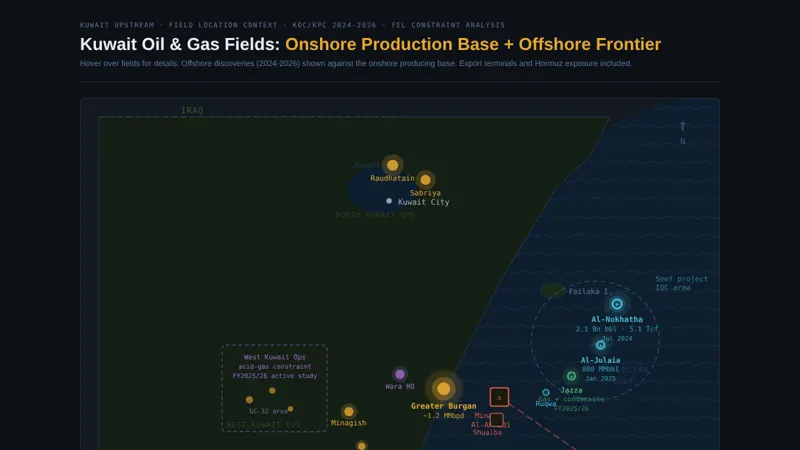
Kuwait oil & gas fields: onshore base + offshore frontier
What interests me is what the transaction reveals about the development system behind the production target.
Kuwait Oil Company's own description of Shaheen is revealing: an "innovative investment model" aimed at maximising returns from strategic infrastructure assets.
That is not the language of a company fixing a pipeline bottleneck. It is the language of a company recognising that infrastructure connecting production to export is itself strategic capital - important enough to attract long-term institutional investment, and significant enough to serve as a funding mechanism for the wider upstream programme.
For anyone working in early-phase engineering, that distinction matters.
Start with the engineering proof
Before geopolitics. Before capital markets.
There is a cleaner example in Kuwait Oil Company's FY2024/25 experience. A delay in completing a 12-inch gas export pipeline constrained crude production from the Khafji Joint Operations to approximately 245,000 bpd. The reservoir was not the problem. The wells were not the problem. One missing gas export connection was.
KOC rerouted two high-pressure gas lines through an existing 30-inch pipeline. The intervention added approximately 40 MMSCFD of gas export capacity, increased crude production from 245,000 to 270,000 bpd, and reduced gas flaring by approximately 18 MMSCFD.
A gas infrastructure constraint became an oil production constraint. The bottleneck was one system layer away from the production target.
That is constraint migration in practice.
When you remove one bottleneck, you don't create capacity. You move the problem.
This is where the KOC/KPC FY2025/26 performance becomes particularly interesting.
Kuwait Oil Company is not failing to execute. Quite the opposite.
In FY2025/26, Kuwait Oil Company drilled 751 new oil wells and completed 1,175 oil-well workovers. It achieved its annual crude production target of 2.72 MMbpd for the second consecutive year.
That is important. Because the argument is not that Kuwait cannot produce. It is that increasing production increasingly requires multiple parts of the system to move simultaneously.
The gap from 2.72 MMbpd to 4 MMbpd is approximately 1.28 MMbpd. That additional capacity cannot be created by drilling alone. It requires the reservoir, wells, surface facilities, water handling, gas processing, export infrastructure and execution capacity to remain aligned as the programme scales.
And the FY2025/26 data show constraints appearing in several of these layers at the same time.
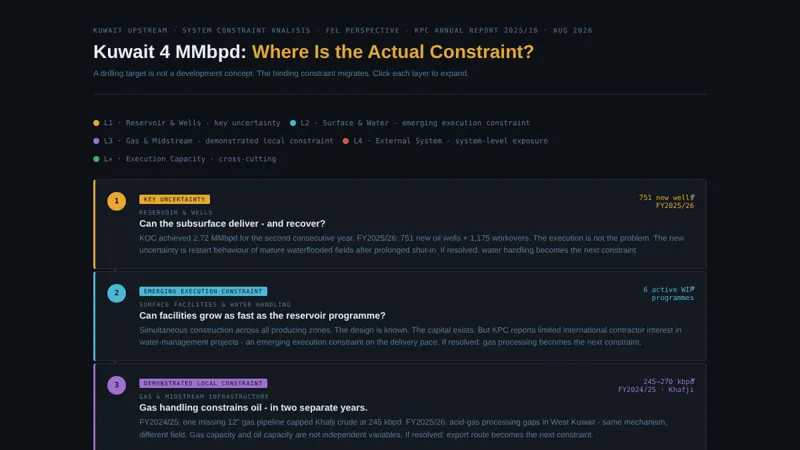
-> Interactive system constraint map: all constraint layers with live data
Before the layers: what the terms actually mean
These distinctions matter because the terms are often used interchangeably - and they should not be.
Reservoir potential is what the subsurface can physically deliver given its pressure, fluid properties and recovery mechanism. Sustainable production is what wells and reservoir together can maintain continuously with pressure support, without accelerating depletion beyond plan. Available production is what the surface system can accept and process - separation, water handling, gas processing, utilities. A well can produce; the facility determines whether those barrels become available. Exportable production is what can physically leave the country through its export infrastructure. Monetisable production is what can actually be sold and economically realised, accounting for commercial, contractual, institutional and market constraints.
The most restrictive combination of constraints determines actual system output - and that combination changes over time.
Layer 1 - Reservoir and wells
Key uncertainty: pressure support and restart behaviour
The first layer remains the foundation. Reservoir quality, reserves, recovery factor, pressure support, well productivity and depletion still determine the underlying economic potential. No amount of infrastructure integration can create barrels that the subsurface cannot deliver.
Kuwait Oil Company's drilling performance demonstrates that Kuwait is actively converting that resource base into production. But the nature of the uncertainty is changing.
Kuwait's mature producing assets increasingly depend on pressure maintenance and water injection. The 2026 regional conflict introduced a new uncertainty for mature waterflooded assets: how does reservoir deliverability recover after prolonged and repeated shut-ins, and is the recovery profile symmetric with the shutdown? This is not yet a demonstrated system-wide constraint. It is a variable that now needs to be explicitly tested in the development basis.
KPC reported it expected to restore approximately 80% of stopped production within one month, with the remainder requiring three to four months. For mature waterflooded assets, however, restart time is not necessarily equivalent to reservoir pressure recovery. A production target based on pre-shutdown deliverability can be technically achievable on paper while becoming less certain in practice - particularly if shut-ins are repeated rather than isolated.
KPC described FY2025/26 as "the biggest shock experienced by Kuwait's oil sector since the Iraqi invasion of 1990." That context sets the scale of the disruption that Kuwait's production system absorbed during the year.
If pressure support holds and deliverability recovers as forecast, the next constraint is already visible: surface facilities and water handling cannot grow at the same rate as the drilling programme without a parallel development effort.
Layer 2 - Surface facilities and water handling
Emerging execution constraint: infrastructure delivery pace
Kuwait Oil Company's FY2025/26 programme includes simultaneous construction of separation and water-injection infrastructure across all operating areas:
- GC-1 and WIP-1 in East Kuwait;
- GC-3 and WIP-3 in South Kuwait;
- WIP-4 in South Kuwait;
- new water injection networks in Sabriya, Bahra and Rawdatain;
- Separation Facility at GC-25 and Water Injection Facility at GC-30 in North and West Kuwait.
More oil. More water. More separation. More reinjection. More power. More interfaces.
A reservoir may have incremental production potential. But if the produced-water handling system cannot grow at the same rate, the production potential does not yet become available production.
The constraint can exist even when the engineering solution is already known. The project may be technically mature. The capital may be available. The need may be undisputed. But if the required contractor capacity is not available at the required pace, the production system still cannot move at the required rate.
The FY2025/26 KPC Annual Report identifies limited international contractor interest in water-management projects as a factor affecting project delivery pace. This is not a generalised contractor shortage - it is a specific signal on a specific project category that belongs in any honest assessment of the programme's delivery risk.
Resolving one constraint does not guarantee that the next constraint is unique. It changes the relative severity of the remaining constraints.
Layer 3 - Gas and midstream infrastructure
Demonstrated local constraint: acid-gas processing
The Khafji example showed the mechanism in FY2024/25. The FY2025/26 KPC Annual Report shows that the same mechanism is active in the current year - in a different field.
Kuwait Oil Company conducted a comprehensive study of acid-gas processing capacity challenges across gathering centres, gas networks and processing facilities in West Kuwait. The study identified operational gaps contributing to increased gas flaring and - critically - constraining crude oil production. KOC subsequently launched six field experiments across West Kuwait Operations and Gathering Centre 32 to address the root causes.
Gas capacity and oil capacity are not independent variables. Khafji demonstrated this in FY2024/25. West Kuwait is demonstrating it in FY2025/26. The constraint migrates in geography - not in mechanism.
Kuwait is simultaneously expanding its gas resource base. The FY2025/26 programme confirmed Jazza Field - with significant gas and condensate potential from the Minagish formation - alongside Jurassic wells at Julaia and Ruqwa offshore. KPC is progressing the Seef project to develop these resources through service-based IOC contracts.
Each future offshore development will potentially add gas gathering, treatment, condensate handling, processing, marine facilities, pipelines and export infrastructure requirements to the wider production system. Resolving one constraint does not guarantee that the next constraint is unique. It changes the relative severity of the remaining constraints.
Constraint migration can begin at discovery, long before FEED.
Layer 4 - External system constraints
System-level exposure: Hormuz chokepoint
Kuwait has no crude export pipeline bypassing the Strait of Hormuz. Saudi Arabia has the East-West pipeline system to Yanbu - around 5 MMbpd design capacity, with the system having operated at up to 7 MMbpd. The UAE has the Abu Dhabi Crude Oil Pipeline to Fujairah - originally designed for 1.5 MMbpd, current reported capacity around 1.8 MMbpd. Kuwait's domestic pipeline network connects production to its export terminals. But the terminals remain exposed to the same regional maritime chokepoint.
When Hormuz access was disrupted in 2026, the system revealed the difference between nameplate capacity and exportable production. Output fell dramatically before recovering as operating conditions changed. The reservoirs were intact. The facilities were intact. But nameplate capacity is not exportable production when the route to market is unavailable.
Project Shaheen does not solve the route concentration risk. It monetises the infrastructure that sits between production and the constraint, and provides capital for KOC's wider investment programme. That is still strategically significant - but it is a different statement.
The constraint that sits across all four layers: execution capacity
There is a fifth variable. It is not another physical layer - it cuts across all four as a cross-cutting constraint.
Reservoir and well programmes require drilling capacity. Water systems require EPC and construction capacity. Gas projects require specialist processing and EPC capacity. Midstream projects require pipeline, fabrication and construction capacity. All of these compete simultaneously for contractor, engineering and regulatory bandwidth.
KOC is simultaneously drilling at a five-year high, expanding water-injection capacity across every producing zone, running six gas processing field experiments and progressing offshore development - all while preparing for a materially higher production target. The FY2025/26 signal on contractor interest in water-management projects is one data point in that picture, not a generalised conclusion. But it illustrates the principle: execution capacity is a system variable, not a discipline-level assumption.
The question this raises is different from the usual reservoir question:
Can the industry deliver all the required infrastructure at the rate at which the subsurface programme is trying to create production?
The chain that defines real system output
Kuwait's 4 MMbpd target is not one number. It is a chain:
Reservoir potential -> Sustainable production -> Available production -> Exportable production -> Monetisable production
The most restrictive combination of constraints determines actual system output - and that combination changes over time.
Remove a water-handling constraint and gas processing may become more restrictive. Expand gas processing and contractor availability may become more restrictive. Increase production and export infrastructure may become more restrictive. Create export capacity and geopolitical exposure may become the dominant risk.
Resolving one constraint does not guarantee that the next constraint is unique. It changes the relative severity of the remaining constraints.
By July 2026, Kuwait was among producers recovering output. The operating environment had changed again - illustrating how the relative importance of export availability and production recovery can change as external conditions evolve.
This is why large development programmes cannot be understood from within a single project boundary. The system is dynamic. The constraint migrates.
And this changes how FEL should be done
The standard early-phase question is: "How much can this reservoir produce?"
That question remains essential. But it is incomplete.
The more useful question is: what is the maximum sustainable, available, exportable and economically monetisable production that the entire system can deliver - and what will become the next constraint when we remove the current one?
A Study Manager should not only ask whether each discipline can meet the target. The Study Manager should also ask: what becomes limiting when this discipline succeeds?
That question changes the scope of a concept study. The study should identify the current binding constraint; the constraints likely to become binding after mitigation; the interfaces between them; the required timing of each mitigation; the execution capacity required to deliver it; and the economic consequence if the mitigation arrives late.
Any concept that reaches FEL-2 gate review without a system-level constraint map is not answering that question. It is answering a simpler one and hoping the rest works out.
The real significance of Shaheen
This is why the $16 billion Shaheen transaction is more interesting than the headline suggests.
It should not be read simply as "Kuwait found a way to raise $7.85 billion." It can also be read as: Kuwait is treating infrastructure as part of the capital architecture of its upstream growth strategy. Institutional capital is being brought into strategic infrastructure while Kuwait retains ownership and operational control.
That does not prove that pipeline capacity is today's binding constraint. It shows that the infrastructure connecting production to monetisation has become important enough to be treated as a strategic asset class - and a source of funding for the wider production programme.
And that is consistent with what the FY2025/26 operating data are showing: the challenge is no longer one constraint. It is the interaction between constraints.
Nameplate capacity is not production. Production is not available production. Available production is not export. Export is not monetisation.
The next 1.28 MMbpd is not simply a bigger version of the same programme. It is a more integrated one.
The 4 MMbpd target will depend on whether Kuwait can make the reservoir, wells, water systems, gas processing, surface facilities, midstream infrastructure, export system and execution capacity move together.
The hardest part may not be removing today's bottleneck.
It may be identifying tomorrow's bottleneck before today's investment creates it.
That is the real system-integration problem.
Sources
- KPC Annual Report 2025/2026: https://www.kpc.com.kw/Publications?filter=AnnualReport
- KPC net profit FY2025/26 - Times Kuwait: https://timeskuwait.com/kpc-reports-2-155-billion-dinars-in-net-profit-for-2025-2026-despite-oil-price-decline-iranian-attacks/
- KPC profit three-year high - AGBI: https://www.agbi.com/oil-and-gas/2026/08/kuwait-state-oil-companys-profit-hits-three-year-high/
- KOC Annual Report 2024/25 - Khafji case: https://www.kockw.com/sites/EN/Annual%20Reports/2024-2025%20English.pdf
- Project Peregrine / Shaheen - Reuters: https://www.reuters.com/business/energy/kuwaits-kpc-signs-16-billion-lease-leaseback-deal-with-blackstone-kkr-brookfield-2026-07-25/
- Kuwait output drop - AGBI: https://www.agbi.com/analysis/oil-and-gas/2026/07/kuwait-oil-output-could-fall-by-a-quarter-on-hormuz-disruption/
- Kuwait production recovery - Arab News: https://www.arabnews.com/node/2646626/amp
- Kuwait pre-war production - CNBC: https://www.cnbc.com/2026/03/07/kuwait-oil-cut-iran-war-strait-hormuz.html
- OPEC output July 2026 - Reuters: https://www.reuters.com/business/energy/opec-oil-output-rises-further-july-led-by-gulf-producers-reuters-survey-shows-2026-08-10/
- Strait of Hormuz / Saudi bypass - EIA: https://www.eia.gov/todayinenergy/detail.php?id=61002
- UAE bypass pipeline - EIA: https://www.eia.gov/todayinenergy/detail.php?hl=en-GB&id=65504
- Interactive constraint map: https://marvelous-stroopwafel-d24f4f.netlify.app